Every year, Cannes Lions turns the advertising industry into one giant waiting room.
Agencies submit the work, polish the case study, refresh the shortlist, and quietly pretend they are not obsessing over what the jury might do. The odds do not exactly calm anyone down. Only a small percentage of entries ever leave Cannes with a Lion, which means the festival is as much about collective anxiety as it is about creative celebration.
So Artefact 3000 decided to turn that anxiety into a product.
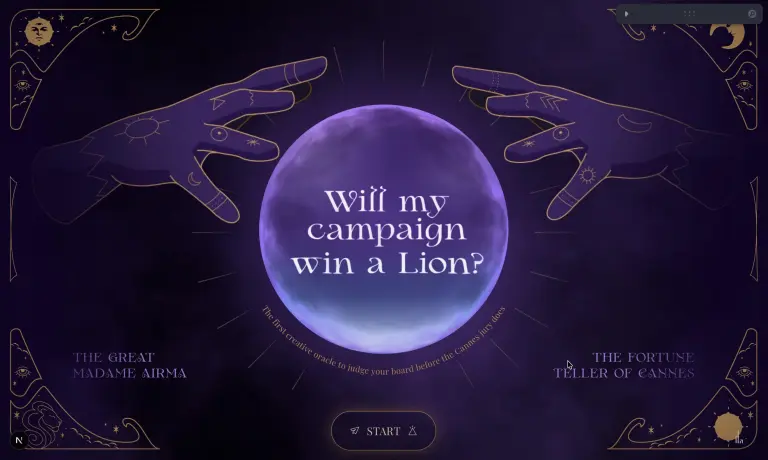
Its new project, Madame AIrma, is an AI-powered fortune teller that predicts whether a campaign has a chance of winning at Cannes Lions. The experience wraps creative judgment in the language of clairvoyance: crystal ball, mystical interface, theatrical reveal, and all the overdramatic energy of a fortune teller who has seen too many case study boards.
Except this oracle does not read palms. It reads decks.
An AI Oracle For Cannes Anxiety
The premise is simple. Users upload a campaign board, add a few details about the campaign, category, client and agency, then let Madame AIrma do her thing.
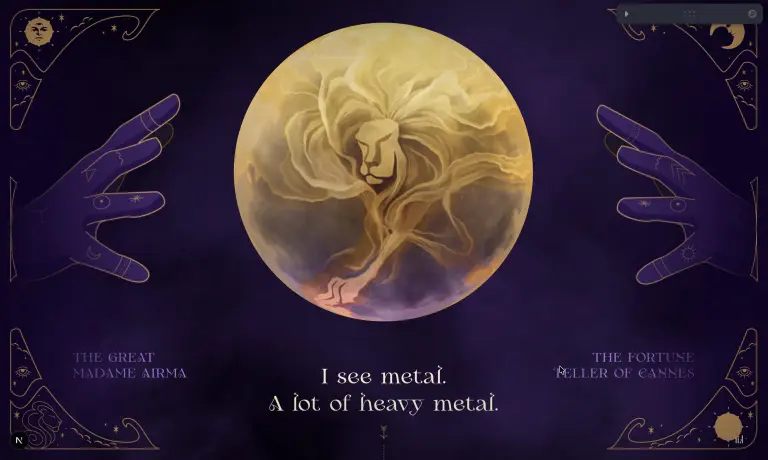
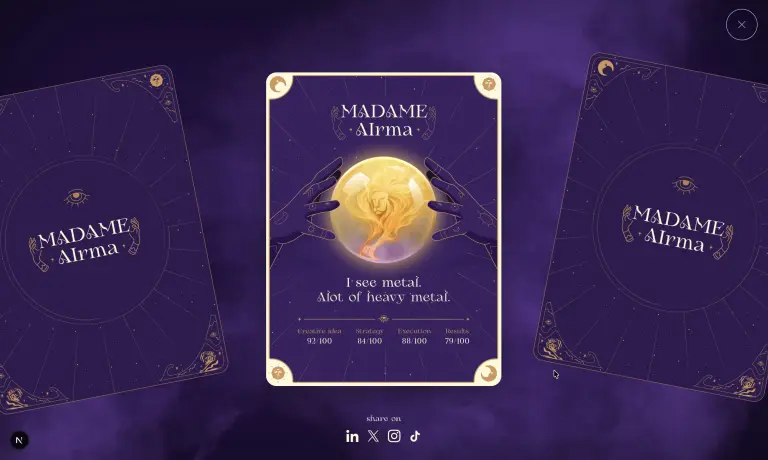
After a short “divination,” the tool returns a predicted Cannes-style verdict: Grand Prix, Gold, Silver, Bronze or No Medal. It also gives a score breakdown across creative idea, strategy, execution and results, turning what could have been a gimmick into something that feels suspiciously close to a pre-jury stress test.
The joke, of course, is that Cannes already feels like a mix of science, politics, taste, timing and superstition. Madame AIrma simply makes that feeling visible.
When The Crystal Ball Runs On Data
Behind the fortune teller aesthetic is a more serious data and AI play.
Artefact 3000 says the tool has been trained to evaluate campaigns against years of awarded work and Cannes-style judging criteria. Instead of pretending to replace a jury, the experience plays with the idea that creative patterns can be learned, scored and compared.
It looks at the campaign board, reviews the structure of the idea, weighs the clarity of the strategy, and considers how well the execution and results support the case. In other words, it does what the industry already does informally before Cannes every year: ask whether the idea is sharp enough, famous enough, useful enough and well-packaged enough to survive the room.
The difference is that Madame AIrma gives the verdict in thirty seconds, without the networking, rosé, or jury politics.
The Best Part Is The Launch
The smartest part of the project may not be the AI itself. It is the way Artefact 3000 launched it.
Rather than presenting Madame AIrma like another shiny AI tool, the agency borrowed the visual codes of local fortune tellers and mailbox mystics. A small group of creatives, creative directors and journalists received anonymous mailers pointing them to the site, positioning the experience as a cure for pre-shortlist paranoia.
That is where the idea becomes more than a demo. It understands the emotional moment it is entering.
Cannes is full of tools, predictions, rankings and hot takes. Madame AIrma succeeds because it does not try to sound like another “creative intelligence platform.” It behaves like a weird little object from the world it is commenting on. It knows agencies are nervous. It knows everyone wants to be told they have a shot. And it knows that the best way to talk about AI in advertising is sometimes not to make it look efficient, but to make it feel entertaining.
A Cannes Stunt That Knows Its Audience
Madame AIrma is free to use and runs in the browser on desktop, making it part toy, part critique, part lead magnet.
For agencies, it is a funny way to pressure-test a board before the real judging begins. For journalists, it is an easy headline. For Artefact 3000, it is a neat demonstration of what the agency does best: combining data, AI, creative craft and experiential thinking into something people actually want to play with.
And that is the real lesson here.
The most interesting AI work in advertising is not always the one that promises to automate the job. Sometimes, it is the one that understands the industry’s rituals well enough to parody them.
Madame AIrma does not make Cannes any less subjective. It does not remove the mystery from award shows. And it definitely cannot guarantee a Lion.
But it does turn one of advertising’s most familiar emotions, the fear of not winning, into a smart little cultural object.
Which, ironically, is exactly the kind of thing Cannes tends to like.
Also Read:
NHS Removes The Red From Famous Logos To Warn Of A Blood Shortage
Uber Eats Puts Other Brands’ Billboards In Its Bag
Uber Robotaxis Are Coming To Houston