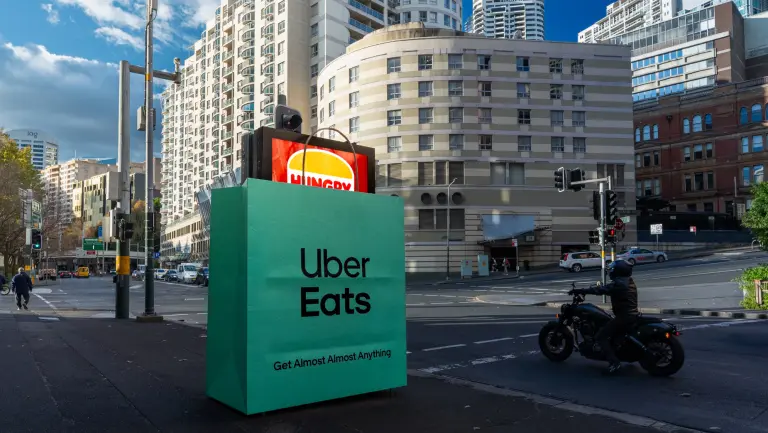
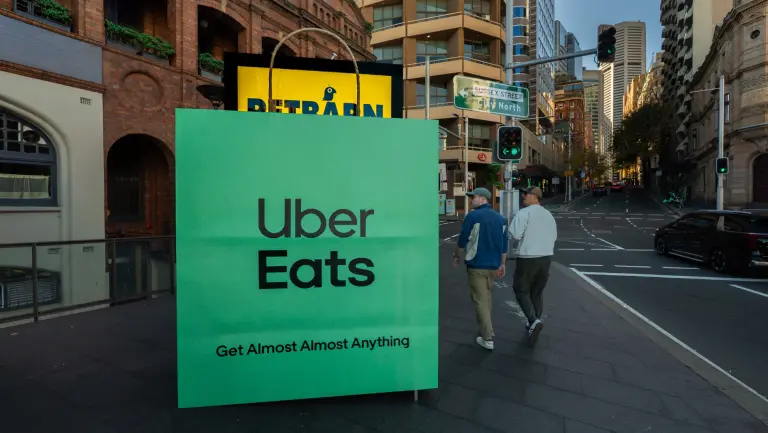
Uber Eats has found a very simple way to prove the size of its catalogue: by turning other brands’ ads into its own.
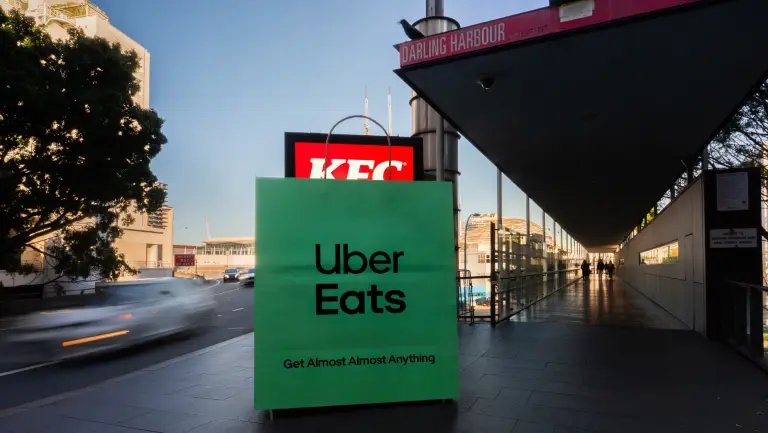
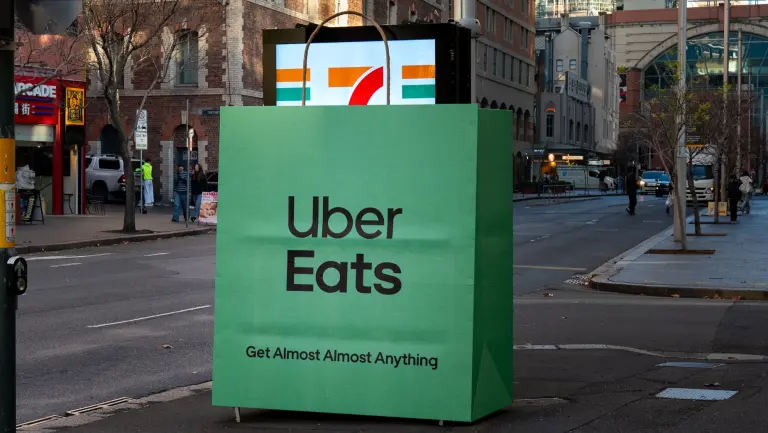
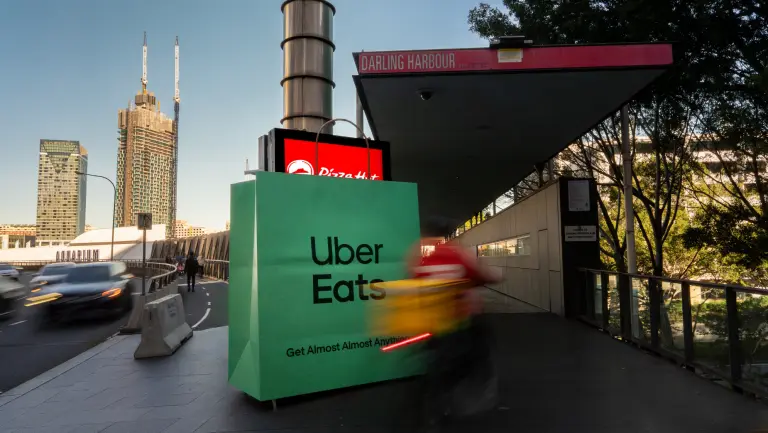
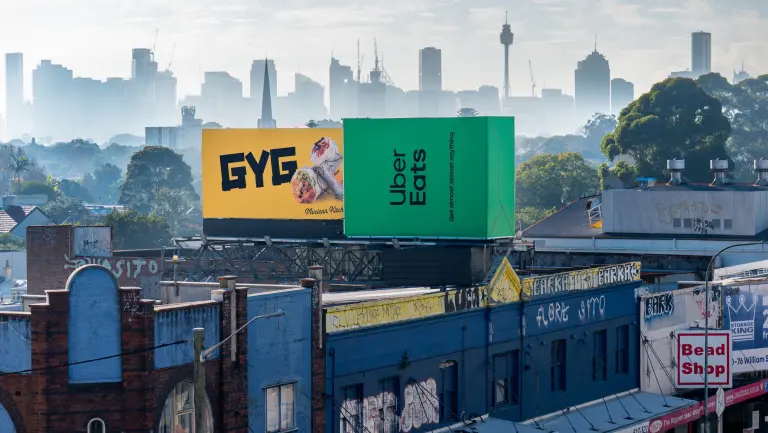
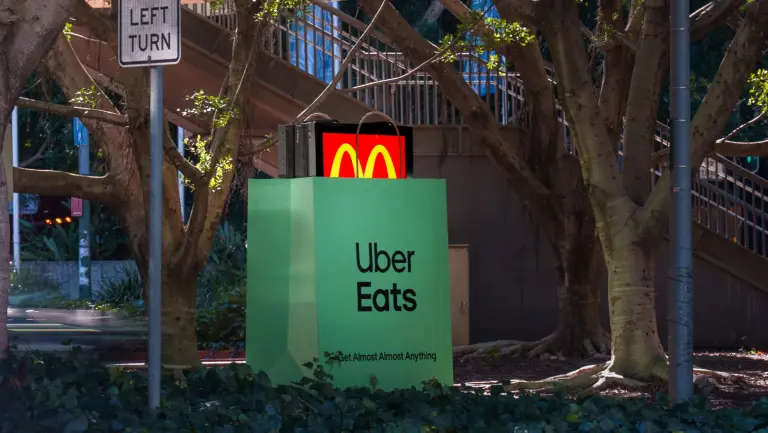
In Australia, the delivery platform has launched the latest chapter of its “Get Almost, Almost Anything” brand platform with an outdoor campaign that does not behave like outdoor advertising at all. Instead of buying space to tell people what it can deliver, Uber Eats has placed giant branded delivery bags over existing billboards for products that are already available through the app.
The result is a piece of media hijacking that feels instantly understandable. A McDonald’s billboard becomes a McDonald’s order. A pet food ad becomes a pet supply delivery. A snack poster becomes something you can get dropped at your door. All it takes is one oversized Uber Eats bag to make the point.
The city was already full of Uber Eats ads
The campaign, created by Special, is built on a lovely observation: almost every outdoor ad you walk past is already advertising something Uber Eats can deliver.
Fast food, groceries, pet supplies, snacks, drinks, convenience items. The streets are full of products competing for attention, but Uber Eats saw a different kind of opportunity. What if all those ads were not competing media, but proof points?
That is what makes the idea work so well. Uber Eats does not need to list its categories. It does not need a long line of copy explaining its range. It simply points to the brands people already recognize and reframes them as things that can be ordered through the platform.
In other words, the campaign turns the city into a catalogue.
An oversized delivery bag becomes a media idea
The oversized bag is doing all the work here. It is not just a logo slapped onto someone else’s billboard. It is a physical intervention that changes the meaning of the media around it. The original ad still does its job. You still see the burger, the product, the brand, the craving. But the Uber Eats bag adds a second layer: you can have that delivered.
That is the beauty of the execution. It is disruptive without being complicated. It is bold without needing to shout. And because the bag is such a recognizable part of the Uber Eats delivery experience, the whole thing reads in a fraction of a second.
The media becomes the message, but more importantly, the media becomes the service demonstration.
Proving the promise instead of saying it
“Get Almost, Almost Anything” is one of those brand platforms that needs constant proof. The line is broad by design, but broad promises can easily become wallpaper if they are not made tangible.
This campaign does exactly that.
Rather than saying Uber Eats delivers more than restaurant food, it shows it through the visual language of everyday advertising. A passerby does not have to imagine the breadth of the offer. They see it on the street, inside a giant green delivery bag.
That shift matters. The campaign takes a functional message, range and availability, and makes it feel playful, physical, and culturally visible. It is not an app screen. It is not a menu grid. It is a public demonstration.
And because the ads being “bagged” belong to other brands, the idea also carries a little competitive wink. Uber Eats is not just placing itself next to those brands. It is placing them inside its ecosystem.
Smart media, smarter context
The special builds are running in high-traffic areas across Sydney and Brisbane throughout June, giving the campaign the kind of public visibility that makes the idea feel bigger than a standard OOH buy.
That matters because the stunt depends on context. It only works when people encounter it in the wild, next to real ads, in the flow of the city. The whole point is that Uber Eats is not inventing a catalogue. It is revealing one that was already hiding in plain sight.
With JCDecaux involved on the out-of-home build and EssenceMediacom on media, the campaign also shows how much craft sits behind an idea that looks effortless. The bag has to land in the right places, over the right kinds of ads, where the joke and the proof can be understood instantly.
It is a simple idea, but not a lazy one.
When hijacking becomes helpful
There is always a risk with brand hijacking. It can feel clever for the sake of being clever, or worse, parasitic without adding anything useful.
This works because the hijack has a purpose. Uber Eats is not borrowing attention just to be cheeky. It is using the existing media landscape to make its core proposition more obvious. The joke is the proof.
That is why the campaign feels so strong. It does not ask people to decode a strategic message. It gives them a visual shortcut. See the ad. See the bag. Understand the service.
For a platform trying to stretch perception beyond takeaway food, that is exactly the kind of simplicity it needs. Uber Eats is not telling Australia it can deliver almost anything. It is walking through the city, picking up other brands’ ads, and putting them in the bag.
Also Read:
With GIF Support LinkedIn Comments Are Getting More Visual
Scotch-Brite Turns Its Sponge Into a Brazil Jersey
Levi’s Turns FIFA Ban into Branding Masterclass