


As AI-generated video becomes harder to distinguish from reality, YouTube is stepping in with a more aggressive approach to transparency. The platform announced that it will now automatically label videos containing “significant photorealistic AI,” even if creators fail to disclose it themselves.
The move marks a major shift in YouTube’s AI moderation strategy.
Until now, the platform largely relied on creators to voluntarily disclose when AI was used in ways that could mislead viewers. Going forward, YouTube says its own detection systems will actively identify AI-generated or AI-altered content and apply labels automatically.
The company also plans to make these labels far more visible across both long-form videos and Shorts. Instead of hiding disclosures inside the expanded description, labels will now appear directly below the video player for traditional videos and as overlays on Shorts.
The goal is simple: make AI-generated content impossible to miss.
YouTube first introduced AI disclosure requirements over two years ago, asking creators to label content depicting realistic people, places, or events generated with AI. Obviously fictional or stylized content, like animated fantasy worlds or surreal edits, remained exempt.
What changes now is enforcement
With increasingly advanced models capable of producing highly realistic video, YouTube no longer wants creators to be the sole gatekeepers of disclosure. The announcement comes just days after Google unveiled Gemini Omni at Google I/O, a new family of multimodal AI systems capable of generating highly detailed video outputs with contextual understanding of physics, culture, science, and history.
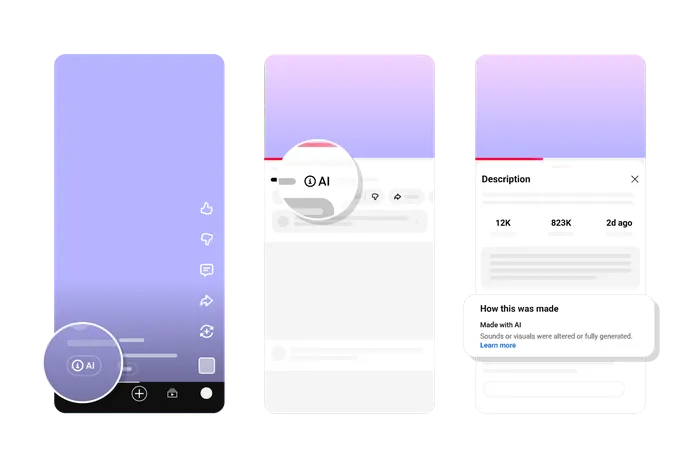
In practical terms, creators are still expected to disclose AI use manually, but YouTube says it will step in if they don’t.
And in some cases, labels will become permanent.
Videos generated using YouTube’s own AI tools, such as Veo or Dream Screen, will automatically carry AI labels that creators cannot remove. The same applies to content containing C2PA metadata, the industry standard designed to certify AI-generated media. OpenAI recently joined the C2PA initiative alongside companies like Nvidia, Kakao, and Eleven Labs.
The update also arrives alongside an expansion of YouTube’s AI deepfake detection systems. After initially testing detection tools with celebrities, politicians, and public figures, the company now allows any adult to scan YouTube for AI-generated face matches tied to their likeness.
Importantly for creators, YouTube says these labels will not affect monetization or recommendation algorithms. At least for now, AI-generated content won’t be penalized simply for existing.
Culturally, the change matters
For years, platforms treated AI disclosure as a creator responsibility. YouTube’s decision signals that AI transparency is becoming infrastructure-level policy instead of an honor system.
And as photorealistic AI video becomes increasingly accessible, visible labeling may soon become as standard as sponsored content disclosures or copyright claims.
The bigger question is no longer whether AI-generated content belongs on platforms. It’s whether audiences will still know what they’re looking at without platforms intervening first.