


The most interesting thing about Roost is not that it lets people send messages. Every app does that. It is that Roost makes people wait for them.
The app describes itself as a way to send notes across the world by bird, and its Google Play listing makes the product promise very clear: no instant delivery, no read receipts, and no pressure to reply the second something appears on screen. Messages travel in real time, carried by virtual birds, with delivery depending on distance and the bird involved.
That is the whole trick. Roost is building a social experience around delay, not speed.
Users start by choosing four birds for their rookery. Those birds then carry notes and doodles to friends. A falcon will arrive faster than a hummingbird because each bird moves at something close to its real-world speed. If that still feels too fast, the app also lets users send snails or turtles.
It is ridiculous in exactly the right way. A virtual woodpecker can take hours to cross the country. A zebra finch can carry a bad doodle into Manhattan. The wait is not a bug or a monetization wall. It is the product.
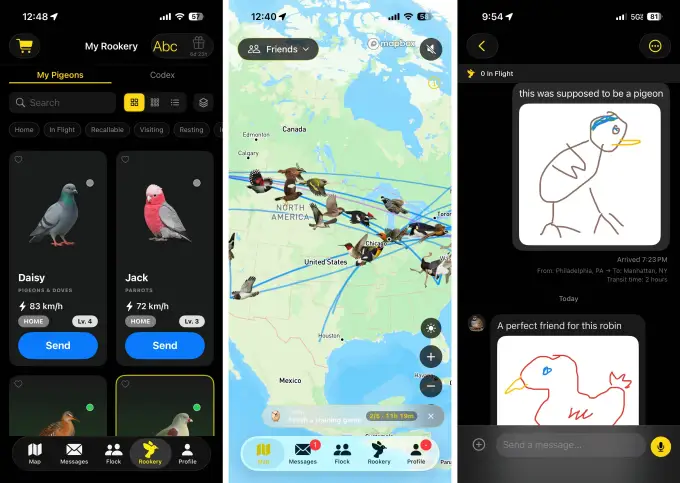
Social messaging, with the urgency removed
Roost was not originally built as a startup growth machine. Its creator, Logan Mendelsohn, is a senior product manager in trust and safety at Ticketmaster, and started building the app as a side project for friends. They liked it enough to push him to put it in the App Store.
Then the niche started to widen. TechCrunch reports that Roost has grown to around 300,000 users, with momentum picking up after a mother posted on Threads about her daughter using the app to communicate with friends in Elizabethan English. That detail matters because it shows what Roost is really unlocking: not just private messaging, but play.
Most messaging products compete on immediacy. Faster delivery, typing indicators, read receipts, presence signals, streaks, nudges, AI replies. The interface keeps telling you that the other person is there, that you are being watched, and that your silence is also a signal.
Roost removes most of that social pressure by making the waiting external. You are not ignoring someone; the bird is still flying. That small fiction gives users a way to communicate without turning every exchange into a live performance.
Friction becomes the feature
There is a reason this is landing now. A lot of people are tired of apps that treat attention like a resource to be extracted in real time. Roost does the opposite. It takes a behavior that platforms usually try to eliminate, latency, and turns it into identity.
That does not mean every platform should start adding birds to messaging. The sharper lesson is that speed is no longer automatically the premium experience. In some contexts, slower can feel more personal, more intentional, and more fun.
For social platforms and brands, that is a useful signal. Audiences are not rejecting digital connection. They are rejecting the feeling that every connection must be immediate, measured, and optimized. Roost’s growth suggests there is room for social products that create anticipation instead of collapsing it.
The strategic consequence is simple: in an always-on feed culture, making people wait can become a form of differentiation.