


YouTube search is starting to behave less like a search box and more like someone who understands what you are trying to do.
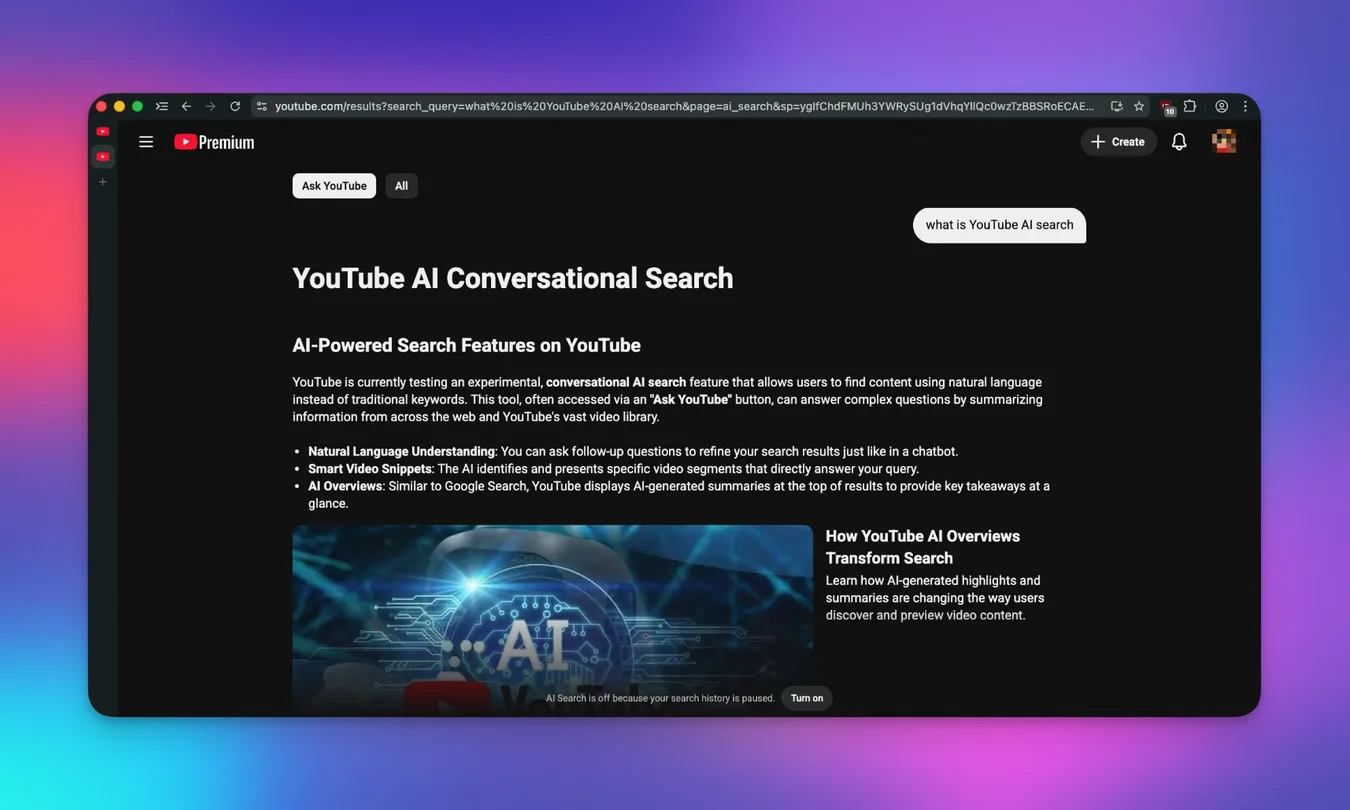
A new AI-powered search experience is rolling out in the US, giving users the ability to ask YouTube for videos using conversational, situation-based prompts rather than only typing exact keywords. As Digital Trends reports, US users can now describe specific situations, ideas, or activities and have YouTube return relevant videos based on that context.
That detail matters. The update is not just about making search faster. It changes the basic input. Instead of searching for a fixed phrase, users can search around a need: a situation they are in, something they want to learn, or an activity they are planning. The system is designed to interpret the intent behind that description and connect it to videos that fit.
In practical terms, this means YouTube is trying to reduce the gap between “I know what to type” and “I know what I need.” That gap has always been one of the quiet frictions of search, especially on a platform where content is visual, long-tail, and often organized around creators’ language rather than the viewer’s.
From keyword hunting to intent matching
The concrete facts are simple: the feature is AI-powered, it is rolling out in the US, it lets users ask conversational questions, and it is built to find videos tied to described situations, ideas, and activities. Together, those facts point to a bigger product shift.
YouTube has spent years becoming the default place people go when they want to see how something works, compare options, plan a trip, fix a problem, cook a meal, learn a skill, or understand a topic through people rather than pages. But the search interface has still largely depended on users translating those needs into the right words.
AI search flips some of that work back onto the platform. The user no longer has to guess the best query. They can describe the problem. YouTube then has to map that description to useful content.
That is a very different relationship between audience and archive. YouTube is not short on videos. It is short on ways to make the right video feel instantly findable when the user does not yet know what to call it.
The creator implication is discoverability by context
For creators, this adds another layer to discoverability. Titles, thumbnails, descriptions, chapters, transcripts, and on-screen context may all become more important if AI systems are being asked to understand what a video is useful for, not just what keywords it contains.
For brands, the same logic applies. A product video, tutorial, review, explainer, or campaign asset may be surfaced less because it matches a tidy search term and more because it answers a real-world scenario. That rewards content that is specific about use cases. It also punishes vague “brand story” videos that look good but do not clearly solve, show, explain, or demonstrate anything.
This is where the update becomes bigger than YouTube. Search across platforms is moving toward natural language, but YouTube has a particular advantage: its answers are not just text. They are people, demonstrations, opinions, instructions, and entertainment. If AI can make that archive easier to navigate, YouTube becomes more useful at the exact moment users are getting used to asking machines for help in plain language.
The strategic consequence is clear: on YouTube, discoverability is no longer only about being keyword-relevant. It is about being situation-relevant.