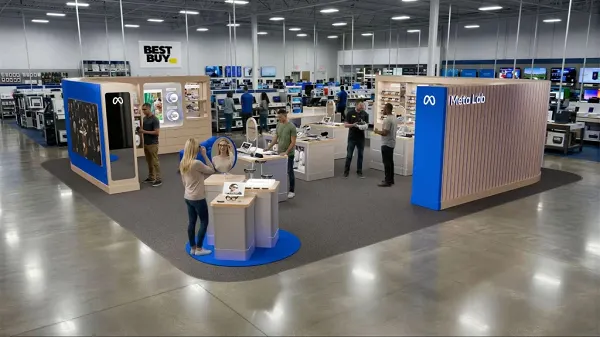
Meta’s next push into AI may not happen first in your feed. It may happen under fluorescent retail lights, with a sales specialist adjusting a pair of glasses on your face.
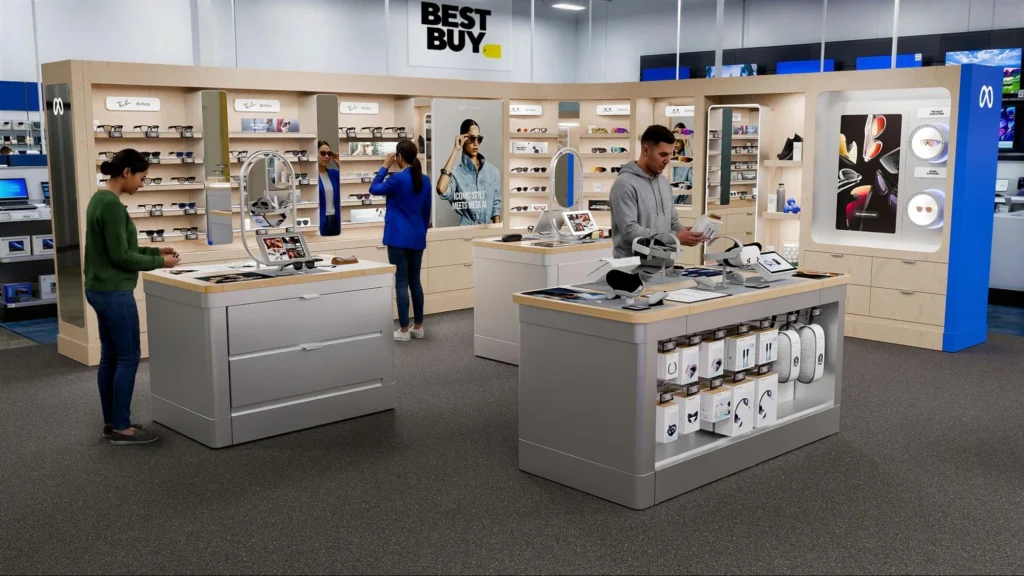
Meta is launching more than 50 Meta Lab spaces inside Best Buy stores across the United States and Canada. Each one is designed as a roughly 900-square-foot store-in-store, built for hands-on discovery rather than simple shelf display.
The spaces will let shoppers test Meta’s expanding lineup of AI glasses and VR headsets through interactive demos, smart mirrors, personalized fittings, and help from dedicated Meta Sales Specialists. That detail matters. Meta is not treating AI wearables like another accessory. It is building a physical explanation layer around them.
AI Wearables Need A Different Kind Of Retail
Meta’s AI glasses are clearly the headline product in this Best Buy rollout. The company has been pushing the idea of always-available AI assistance, with glasses becoming the interface that can see, hear, and respond in the moment. That is a very different sell from a phone, a smartwatch, or even a VR headset.
You can understand a phone by looking at the screen. You understand AI glasses by wearing them. The camera position, the fit, the voice controls, the social comfort of having technology on your face, all of that is hard to explain in a product listing.
That is why the 900-square-foot format is more than a retail footprint. It is a conversion tool. Smart mirrors and personalized fittings are not decorative additions; they are designed to remove the awkwardness that comes with trying a new category of device in public.
Meta has learned this before. VR often needed demos because the value only became obvious once someone put on the headset. AI glasses create a similar challenge, but with a more everyday object. The promise is not escape into a virtual world. It is assistance layered onto ordinary life.
The Numbers Give Meta A Reason To Go Bigger
This move also comes at a moment when Meta has more than hype to point to. Social Media Today cites CNBC reporting that 7 million pairs of Meta’s AI glasses were sold in 2025, up from 2 million combined across 2023 and 2024.
That jump suggests the reframing of smart glasses around AI is working. Earlier versions of connected glasses often felt like niche camera gadgets. AI gives the format a clearer everyday use case: ask questions, capture moments, translate, identify, remember, or get help without pulling out a phone.
Best Buy gives Meta a way to turn that interest into behavior. Online buzz can make people curious. A retail demo can answer the quieter questions: Do these look normal? Do they fit my face? Would I actually wear them? What can they do that my phone cannot do quickly enough?
Meta is also reportedly leaning into cultural adoption, including a push to get more celebrities and influencers wearing its AI glasses. That is the other half of the problem. Wearables need utility, but they also need permission. If people are going to put AI on their face, they need to see it used in normal, desirable, and socially acceptable ways.
What Brands Can Learn From Meta’s Store-In-Store Bet
For brands and marketers, the useful lesson is not simply that Meta is opening pop-ups. It is that some technologies cannot be marketed through claims alone.
The Best Buy setup combines demo, education, fitting, and social proof in one place. That is important for any product where the barrier is not awareness, but comfort. AI glasses raise practical questions and emotional ones at the same time. Consumers are not just asking whether the product works. They are asking whether it belongs in their daily life.
That changes the role of retail media and in-store experience. A 900-square-foot space staffed by dedicated specialists is expensive compared with a display stand, but it gives Meta something digital ads cannot: the chance to let people try the behavior before asking them to buy into the idea.
For marketers building around AI products, wearables, connected devices, or any category that changes personal habits, this is the point. Demonstration is becoming part of persuasion again. The more intimate the technology, the more physical the sales experience may need to be.
Before AR Arrives, Meta Needs The Habit
The bigger strategic play is clear. Meta has long been working toward augmented reality glasses, but mainstream AR still depends on hardware, comfort, battery life, price, and social acceptance. AI glasses can act as the bridge.
They give Meta a way to train consumers to speak to glasses, wear cameras, use voice-first assistance, and accept AI as something present in the world rather than hidden inside an app. Best Buy’s Meta Labs are designed to make that behavior feel less strange.
This is why the retail rollout matters. Meta is not just selling devices. It is trying to make face-worn AI feel ordinary before the next computing interface arrives. If it succeeds, the advantage will not be one more store placement. It will be consumer habit, built one demo at a time.
Also Read:
Snapchat Turns Ads Into Conversations With AI Sponsored Snaps
Instagram Adds “AI Creator” Labels to Boost Transparency
LinkedIn Is Using AI To Rethink How Your Feed Actually Works