


LinkedIn has spent the past few years adding AI tools across its platform. Now, it is giving users a way to call out when that same technology goes too far.
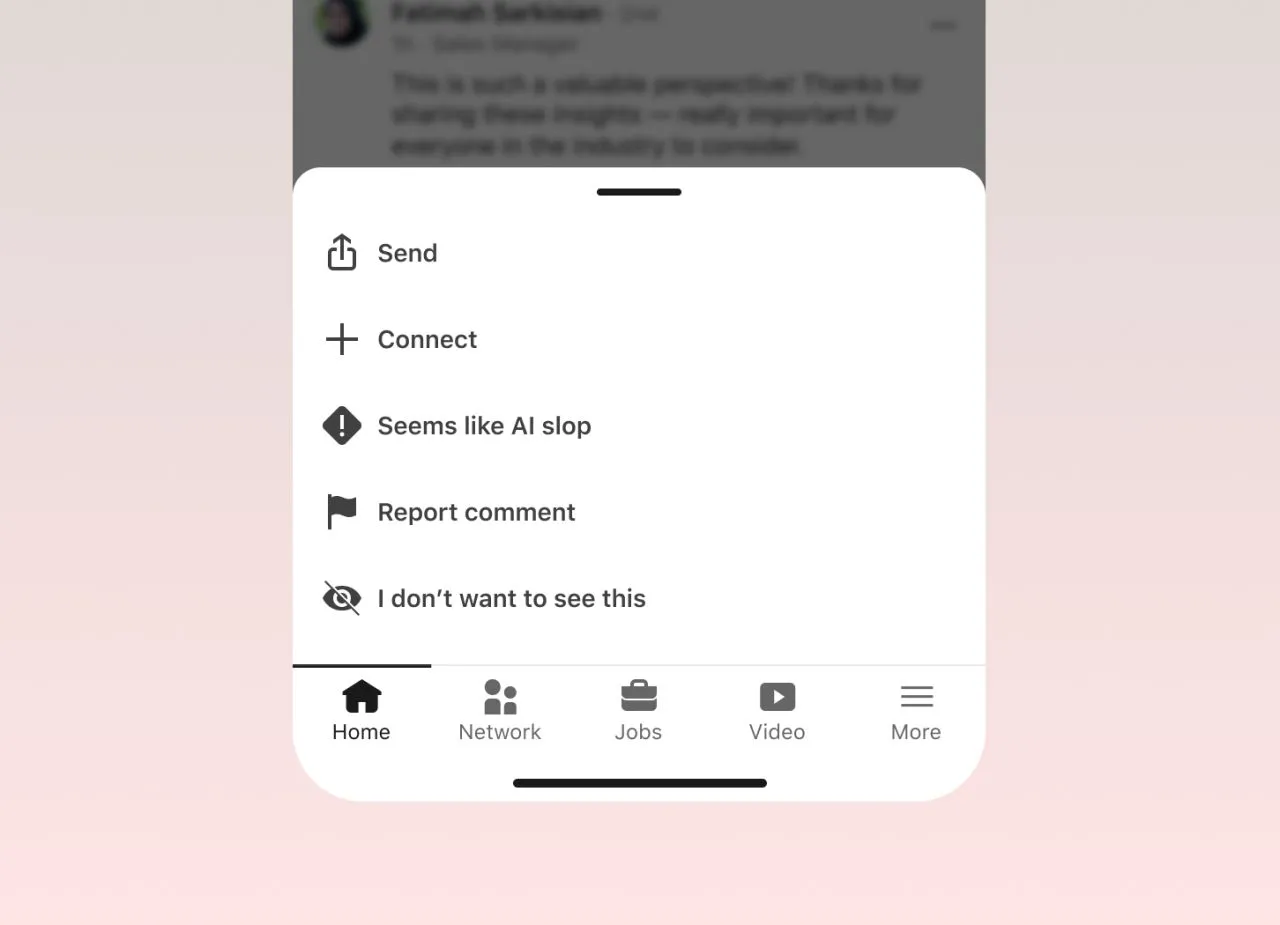
The professional network is introducing a new “Seems like AI slop” button that lets people flag posts they believe are low-quality, artificially generated, or simply no longer sound like they came from a real person.
It is part of a broader effort by LinkedIn to reduce the amount of generic, automated content appearing in the feed and, more importantly, protect the thing the platform still depends on most: people wanting to hear from other people.
LinkedIn Wants Users To Help Spot The Slop
LinkedIn Chief Product Officer Hari Srinivasan acknowledged the problem directly, saying that tackling AI slop has become a major priority for the company.
The new button will give users a direct way to signal when a post appears excessively AI-generated. Those reports will not only provide feedback on individual posts; LinkedIn also plans to use them as training signals for the classifiers it is building to identify low-quality AI content automatically.
Those classifiers will play a particularly important role in suggested posts from outside a user’s immediate network. If LinkedIn determines that a piece of content looks like AI slop or otherwise lacks quality, it can reduce how often that post gets recommended.
In other words, sounding artificial could increasingly become a distribution problem.
Heavy AI Use Could Show Up In Your Analytics
LinkedIn is also introducing a more subtle form of feedback for creators.
When other users believe someone’s content feels inauthentic because of excessive AI use, LinkedIn may privately surface that information inside the creator’s dashboard.
The distinction matters. LinkedIn is not treating every use of generative AI as inherently bad. Someone might use AI to tighten a sentence, organize an idea or refine something they already wrote.
The problem starts when the tool effectively becomes the author.
By keeping this feedback private, LinkedIn says it can help users understand when their writing has crossed that line without publicly labeling their content as AI-generated.
LinkedIn Is Pulling Back One Of Its Own AI Writing Tools
Perhaps the most telling part of the announcement is that LinkedIn is also changing its own approach to AI-assisted posting.
The platform is removing its “enhance your post” feature, which could rewrite a user’s content using AI.
In its place, LinkedIn will offer a proofreading tool designed to correct the writing without changing the author’s voice.
That is a notable change in philosophy.
The first wave of generative AI tools was largely built around the idea that AI should write more for us. LinkedIn now appears to be moving toward a model where AI helps polish what a person has already written instead.
For a platform built around personal reputation, expertise and professional identity, preserving that voice suddenly matters a lot more.
The AI Slop Problem Goes Far Beyond LinkedIn
LinkedIn is not alone in trying to solve this. Substack recently introduced technology from AI-detection company Pangram to help identify AI-written content on its publishing platform, while Pangram itself announced $9 million in new funding to develop tools aimed at the growing volume of artificially generated material online.
Other platforms have faced an even more fundamental version of the problem: distinguishing actual users from bots and automated activity at scale.
LinkedIn says it is already blocking hundreds of thousands of automated comment attempts every day, alongside millions of other automation attempts over the past several months.
It is also expanding access to profile and Page verification and giving users more control over unwanted interactions, including the ability to block comments from company Pages.
The individual features may look small. Together, however, they point toward a much larger change in how platforms are beginning to think about AI.
For the past few years, the race was to make it easier for everyone to generate more content.
The next one may be figuring out which of that content is actually worth seeing.