


Meta is making Reels travel a little further without asking creators to become localization teams.
The company has updated its Meta AI translation for Reels, expanding the feature to Japanese, Korean, French, German, and Italian. The original announcement, first published in October 2025 and updated on July 14, 2026, positioned the tool as a way to help people discover Reels from around the world. It had already added Hindi and Portuguese, with Meta saying more languages were on the way.
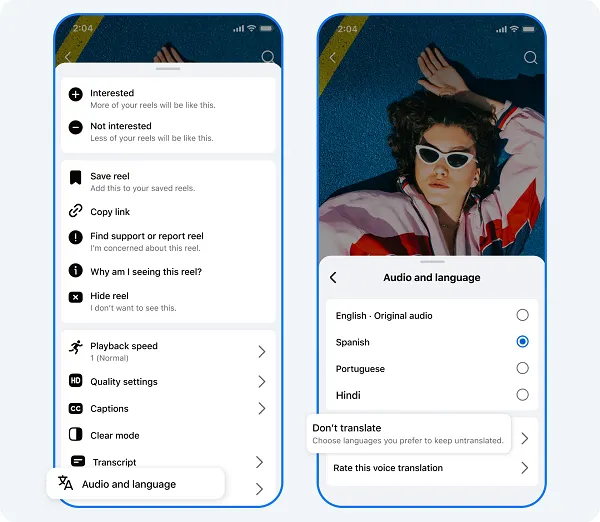
The feature uses Meta AI to translate spoken audio in Reels, generating a dubbed version so viewers can understand creators speaking another language. Meta has also been building the experience around more than subtitles: the company describes AI translation as a way to make content feel more natural across languages, including voice translation and lip-syncing where available. The translation is shown to viewers as AI-generated, keeping the platform’s disclosure layer close to the experience itself.
That matters because Reels already behaves like a global format. A cooking clip, street interview, beauty tutorial, comedy bit, or behind-the-scenes creator post does not need to be from your country to make sense in your feed. But language still puts a hard edge around what can spread. Meta is now trying to soften that edge inside the product itself.
From translated content to native distribution
For years, localization has mostly been something creators and brands had to plan around: captions, duplicate edits, regional accounts, extra voiceovers, or market-specific publishing calendars. That work is still valuable, especially when culture and language do not map neatly onto each other. But Meta’s update shifts part of the job from production workflow to platform layer.
On Instagram and Facebook, that could change what “local” content means. If a Reel can be translated and dubbed automatically, its potential audience is no longer defined only by the creator’s spoken language. A French creator can become easier to watch in Korea. A Japanese tutorial can land with an Italian viewer. A German explainers account can become more discoverable outside German-speaking markets.
The point is not that AI translation will suddenly make every Reel global. Tone, humor, slang, references, credibility, and visual context still matter. A translated joke can still die on arrival. A translated product review can still miss the buying context. But the first barrier, basic comprehension, is becoming less of a creator-side problem and more of a feed-side capability.
That is a meaningful change for Meta. Reels competes on volume, velocity, and recommendation quality. Better translation gives the recommendation system more usable inventory across markets, without waiting for creators to manually produce different versions of the same post. In other words, Meta is not only helping viewers understand more Reels. It is giving Reels more places to go.
The new creator advantage is being understood faster
AI dubbing can translate words. It cannot automatically translate taste, trust, or cultural permission. That means the best use case is not replacing regional strategy, but extending content that already has visual clarity, simple storytelling, and broad relevance. Product demos, tutorials, reactions, travel, food, fashion, fitness, and creator-led explainers are obvious winners because the video already carries much of the meaning.
There is also a trust layer to watch. Meta’s disclosure that translations are AI-generated is important because synthetic voice and lip-syncing sit close to identity. If viewers feel tricked, the feature becomes a credibility problem. If they understand what is happening, it becomes a convenience layer.
Meta’s bigger bet is clear: the next growth engine for short-form video may not be another editing tool or a new remix format. It may be removing language as a default limit on distribution. For creators and brands, that makes the strategic question simpler and tougher at the same time: if your Reel can be understood almost anywhere, is the idea strong enough to travel?