


The European Union’s latest AI transparency rules are officially in effect, bringing new disclosure requirements for chatbots, deepfakes and other AI- generated content.
Since August 2, companies operating in Europe must make it clear when someone is interacting with an AI system rather than a human. Certain AI-generated or manipulated content must also be labelled, while synthetic outputs need machine-readable markers that allow platforms and detection tools to identify their artificial origin.
The measures form part of Article 50 of the EU AI Act and are intended to make artificial content easier to recognize as generative tools become increasingly embedded across social platforms, customer-service systems and digital media.
Different rules for AI makers and users
The obligations distinguish between AI “providers” and “deployers.”
Providers are the companies that develop and place AI systems on the market. They must design interactive systems, including chatbots, to explicitly inform people that they are communicating with AI unless it is already obvious from the context.
Providers must also add machine-readable markings to AI-generated or manipulated images, video, audio and text. These technical signals are intended to remain detectable even when content moves between services.
Deployers are the businesses, platforms and publishers that use those systems. They must disclose when people are exposed to deepfakes, emotion-recognition technology or biometric categorization tools.
AI-generated text covering matters of public interest must also be labelled when it has been published without human review, editorial control or someone assuming responsibility for it. Text that has been reviewed and approved by a human editor is exempt from that requirement.
The EU has created its own AI labels
To make those disclosures more consistent, the European Commission has released a set of standardized icons that platforms, publishers and creators can use.
The system includes labels for content that is fully AI-generated, partially modified with AI or created with some form of AI involvement. The icons can be displayed in black or white, with transparent versions available for different types of content.
Using the EU-designed icons is optional. Labelling qualifying content is not.
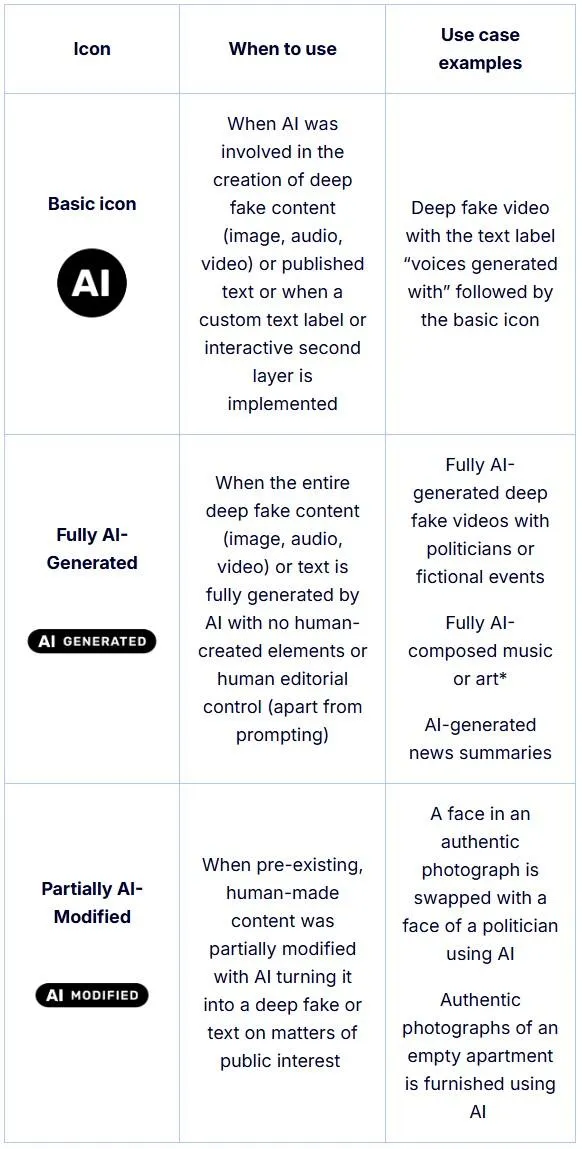
The Commission says disclosures should be visible when someone first encounters the content and should remain attached when it is downloaded or reshared. Labels should also use accessible, straightforward language rather than technical terminology.
Not every use of generative AI needs a prominent warning. The rules focus on deepfakes that could falsely appear authentic and unreviewed AI-generated text concerning matters of public interest.
Artistic, fictional, creative and satirical content may use less intrusive disclosures, provided people can still understand that AI was involved.
Noncompliance could become expensive
Companies that fail to meet the requirements could face fines of up to €15 million or 3 percent of their total worldwide annual turnover, whichever is higher. Enforcement will primarily sit with national market-surveillance authorities, with the EU’s AI Office overseeing certain systems that fall under its jurisdiction.
The rules apply immediately to new systems introduced from August 2.
Systems already on the market before that date receive a limited transition period until December 2, 2026, but only for the requirement to add machine-readable markings to generated and manipulated content. Other transparency obligations already apply. Content produced before August 2 does not have to be labelled retroactively.
Social platforms including TikTok, Instagram and Facebook already display their own versions of AI labels. The EU’s intervention now begins shifting those disclosures from voluntary platform features into enforceable requirements.
For users, the result may initially look like another small icon attached to a post, image or video. For the companies building and distributing AI, however, transparency is no longer simply a product-design decision. In Europe, it is now part of the cost of doing business.