Robotics has no shortage of impressive demos. The harder test is whether a machine can keep doing useful physical work when the object, angle, texture, or point of contact changes.
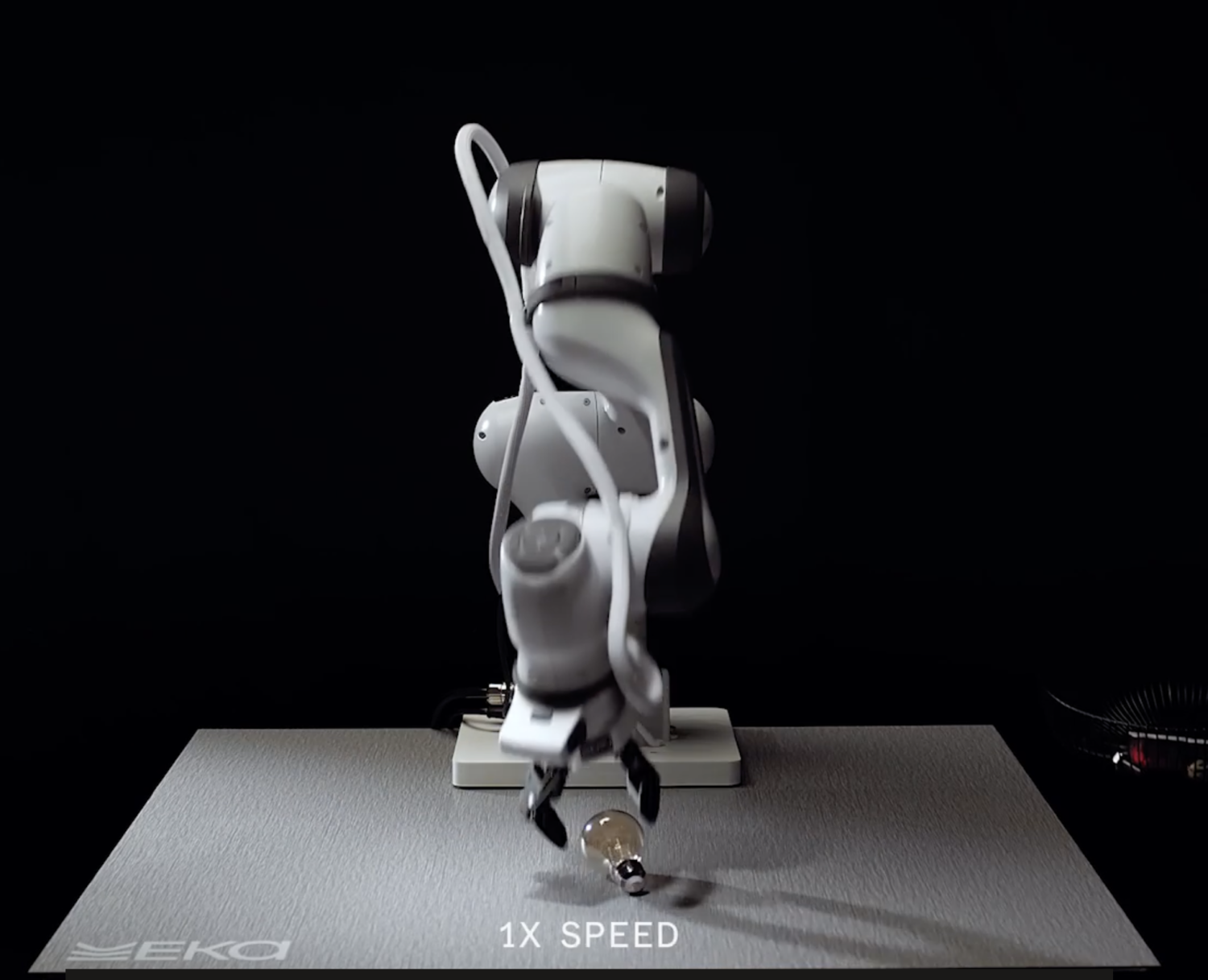
That is why Eka Robotics is attracting attention. The startup has built a robotic manipulation system around a force-sensitive gripper and a vision-force-action model, rather than relying on vision alone. Eka has raised $150 million in a Series A round at a $1.45 billion post-money valuation, while its founders argue that the approach can close one of robotics’ most persistent gaps: making machines both general and consistently competent.
The important shift is from seeing to feeling
Most current discussions about AI-powered robots focus on the model’s ability to interpret images, language, and instructions. Eka’s bet is that this is not enough for the final centimetre of a task. A robot can identify a raspberry, a plate, or a wire. It still needs to know how much pressure to apply, whether an object is slipping, and when to slow down before contact becomes damage.
That is the logic behind Eka’s vision-force-action model. Vision determines roughly where an object is and what shape it has. Force helps the machine complete the grab. The company’s custom hand includes more flexibility and force sensors, allowing it to react to contact instead of treating the object as a fixed visual target.
According to the reported figures, Eka’s system can pick up about 1,500 objects weighing up to one kilogram in an hour, compared with roughly 600 for a human, and the company says it succeeds more than 95% of the time. Those numbers are significant, but the more revealing detail is the machine’s behaviour when a task goes wrong. It can try again without retraining, adapting to a wide range of objects.
The real product is dependable physical behaviour
This points to a broader change in how useful AI systems may be built. The intelligence that plans a task does not necessarily need to be the same intelligence that executes every physical movement. A general model might know that plates belong in a cupboard. A specialised manipulation model needs to know how to pick one up without breaking it.
Eka says it generates thousands of hours of robot experience in minutes through simulation and reinforcement learning. That gives the system a route beyond the limits of human demonstrations, which are expensive, slow, and difficult to scale. It also reflects a pattern appearing across AI: the most valuable layer may be the one that handles a narrow, messy part of reality extremely well.
But the distance between a laboratory demonstration and an industrial line remains substantial. Eka is reportedly working on pilots involving pick-and-place and wire manipulation. The open questions are whether the system can run for a full year without failure, whether it can handle more value-added tasks than basic sorting, and whether its hardware can reach the 20 million duty cycles expected of standard industrial arms. Its gripper is currently rated for five million.
That is the strategic consequence. Physical AI will not become commercially important simply because robots look more human or understand more instructions. It will matter when specialised systems can quietly absorb the fragile, repetitive parts of work that vision-only models still mishandle. Eka’s approach suggests the next competitive advantage may come from teaching machines how the world pushes back.
That same separation between a general-purpose AI layer and a specialised execution layer is beginning to shape consumer products too, including Amazon’s Bee, which turns everyday conversations into AI tasks and shopping prompts. In both cases, the promise is less about a chatbot producing an answer and more about an AI system taking responsibility for a useful next action.
Also Read: