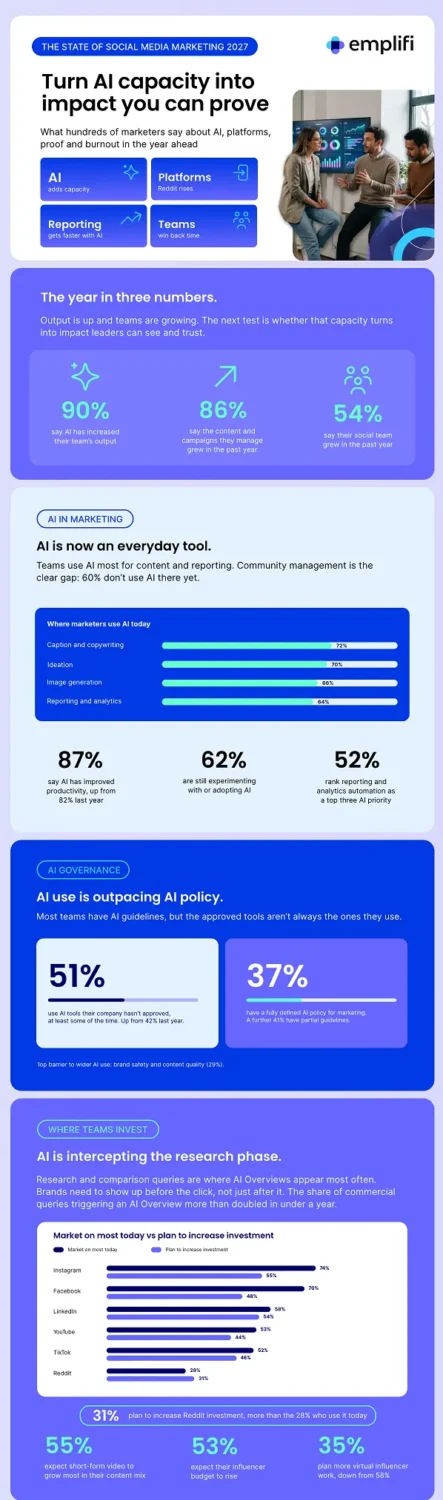
AI is not shrinking social teams in the way some early workplace predictions suggested. At least, that is what the latest set of survey findings summarized by Social Media Today appears to show.
Emplifi surveyed 405 marketing managers, directors, and executives about AI use, product and brand discovery, and social engagement. The headline result is a useful correction to the simplistic idea that automation automatically means fewer people: 90% of respondents said AI had increased their team’s output, while 54% said their social media team had grown rather than contracted.
That points to a more complicated shift. AI is becoming a capacity tool for social teams, not a replacement plan.
AI is absorbing the reporting burden first
The clearest practical use case in the survey is reporting. Sixty-nine percent of respondents said AI tools save them at least three hours per week on reporting.
That number matters because reporting is one of the least glamorous, most repetitive parts of social work. Teams still need to collect platform data, compare performance, assemble updates, explain anomalies, and turn a messy stream of metrics into something a wider organization can understand. AI can reduce the time spent assembling that picture.
But saving time on reporting is not the same as making better decisions. A faster dashboard does not automatically reveal why a format worked, whether a creator partnership built trust, or whether a spike in engagement was commercially meaningful. The value arrives when teams use the recovered time for interpretation, testing, and stronger creative work.
That is also why the staffing figure is more important than the productivity figure alone. If output rises while teams grow, the expectation is probably not that social work becomes easier. It is that teams are asked to produce more, across more surfaces, with more speed and more precision.
AI may remove some manual tasks while raising the volume of work that remains.
Short-form video still sets the pace
Fifty-five percent of respondents expect short-form video to continue growing in relevance and influence. That is hardly a surprising prediction, but it reinforces where the pressure is moving: toward a constant need for native, adaptable, platform-specific content.
Short-form video is not simply another format to add to a content calendar. It changes the operating rhythm of a social team. Ideas need to be found, produced, edited, published, measured, and often repurposed at a pace that traditional campaign structures struggle to support. More output creates more opportunities, but it also creates more decisions.
This is where the survey’s AI and video findings connect. If AI handles parts of the reporting and production workflow, teams can spend more time deciding which ideas deserve attention. That does not make strategy less important. It makes judgment more exposed. When production becomes easier, the difference between useful content and filler becomes harder to hide.
The same shift is visible in creator workflows. YouTube’s move to give every Shorts creator custom thumbnail control shows how much presentation and packaging still matter even inside fast, vertical formats. More content does not remove the need to earn the click or the pause.
For brands, the practical consequence is straightforward: do not treat AI as a headcount calculator. Treat it as a way to increase the number of meaningful choices a team can make. The organizations that benefit will not be the ones that simply publish more. They will be the ones that use saved time to improve creative judgment, understand discovery behavior, and decide where human attention is still worth spending.
The survey findings suggest that social teams are entering a higher-output phase, not an endgame. AI is taking work out of the workflow, but it is also making the remaining work more strategic, more visible, and harder to fake.
Also Read: