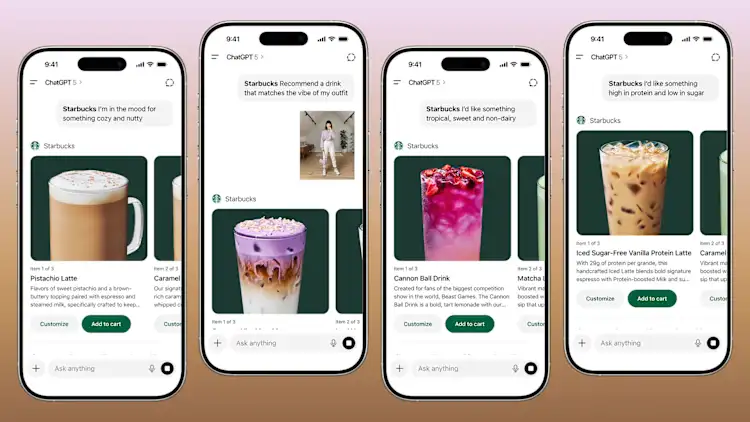
Not sure what to order? Starbucks is betting that the answer doesn’t live in its menu anymore, it lives in your head.
Starting April 15, the brand is testing a new integration with ChatGPT that lets users generate drink ideas conversationally before ever opening the Starbucks app. By tagging @starbucks inside ChatGPT, users can access a beta experience designed to recommend drinks based on mood, cravings, or even images.
Instead of scrolling through a menu, you might type something like “I need an iced pick-me-up”and get back a curated list of suggestions, including more niche or lesser-known drinks you probably wouldn’t have found on your own. From there, you can tweak the order and send it straight into the Starbucks app to purchase.
It’s a subtle shift, but an important one
“Customers aren’t always starting with a menu. They’re starting with a feeling.”
That line from Starbucks’ SVP of digital and loyalty, Paul Riedel, says it all. This isn’t about convenience, it’s about owning the moment before intent becomes action.
Because what Starbucks is really doing here is inserting itself upstream. Not at the point of purchase, but at the point of imagination.
And that’s where things get interesting.
From Menu Navigation to Mood-Based Discovery
For years, ordering Starbucks has been a mix of habit and minor chaos, endless combinations, secret menu hacks, seasonal drops. But it still required effort. You had to know what you wanted (or at least how to find it). This flips that dynamic.
Now, instead of navigating options, users describe a feeling, and let AI translate that into a product. It turns ordering into a kind of co-creation process, where the interface is no longer a menu, but a conversation. It also opens the door to something Starbucks has always struggled with: surfacing the long tail of its menu.
AI doesn’t just recommend the obvious. It can surface the weird, the niche, the overlooked. And in doing so, it quietly increases product discovery without changing the menu itself.
Starbucks Isn’t Alone
Starbucks joins a growing group of retailers experimenting with conversational commerce inside ChatGPT, including Etsy and Walmart.
The logic is simple: people are increasingly using AI not just to search, but to think. To explore ideas. To refine желания into decisions. And if that’s where the journey starts, that’s where brands need to show up.
But Do People Actually Want This? Not everyone is convinced.
Some users have pointed out the obvious: ChatGPT can already recommend Starbucks drinks without Starbucks being involved. Others question the need entirely, do we really need AI to customize a latte?
Fair. But that criticism might miss the point. This isn’t about utility alone. It’s about presence.
Because if AI becomes the default layer between people and decisions, brands won’t compete on shelf space anymore, they’ll compete on whether they’re part of the conversation at all.
Also Read:
Capsule Coffee Is Having Its Streetwear Moment
Instagram Finally Lets You Reorder Carousel Posts After Publishing
From Hype to Sip: How Drop Culture is Reshaping Food and Drink Branding