


Meta’s AI bill is starting to look like a subscription strategy.
The company appears to be adding two paid tiers for its AI tools: Meta AI Core and Meta AI Premium. The packages surfaced based on screenshots posted by app researcher Radu Oncescu. Both tiers reportedly expand access to Meta’s AI tools, including more capacity for image and video creation, with Premium sitting at the higher end and Core offering a middle option for users who want more than the free experience without paying for the top tier.
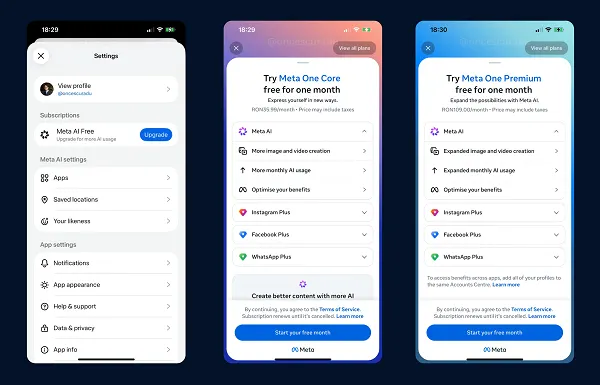
The more interesting detail is the bundle. The reported packages also include Facebook Plus, Instagram Plus, and WhatsApp Plus profile verification benefits, along with improved account support. That turns the offer into something bigger than a prompt box with a price tag. Meta is not only trying to sell more AI usage. It is attaching AI capacity to the paid identity layer it has already been building across its apps.
AI Is Being Packaged With Trust, Not Just Tools
That distinction matters. Standalone consumer AI subscriptions are a hard sell unless the user has a clear recurring need. More image generation, more video creation, and wider access to tools can be useful, but usefulness does not automatically become habit. Meta’s advantage is that it can wrap AI into benefits people already understand: verified profiles, better support, and paid account status across Facebook, Instagram, and WhatsApp.
This is where the reported Core tier becomes especially revealing. Premium subscriptions usually speak to power users. A middle tier speaks to normalization. It gives Meta a way to move AI from occasional experimentation into a paid add-on for people who may not think of themselves as AI users, but do think they need more creation capacity, more account credibility, or faster help when something goes wrong.
It also fits a broader Meta pattern: individual apps are increasingly being managed as pieces of a larger product stack. We saw a similar platform logic in Threads joining Meta’s parental supervision stack, where the feature was less about one app and more about extending a shared control layer across the company’s ecosystem. With these AI subscriptions, the shared layer is monetization: identity, support, and creation bundled across the family of apps.
The Subscription Is Also An Investor Story
The timing is not subtle. Meta has committed more than $600 billion to AI infrastructure development in the U.S. over the next three years, according to the same Social Media Today report. That scale puts pressure on Meta to show that AI is not just a cost center powering better feeds, ads, and internal tools. It needs visible revenue paths that users and investors can understand.
Subscriptions are one of the cleanest ways to tell that story. They create a direct line between AI investment and consumer revenue, even if the bigger long-term payoff may still come from advertising, recommendations, business tools, and automation inside Meta’s platforms. The reported AI tiers give Meta a product it can point to: here is AI access, here is more creative capacity, here is verification, here is support, here is why you might pay monthly.
There is also internal pressure around what AI is supposed to replace or improve. Social Media Today points to Reuters reporting that Meta staff pushed back against a plan that would have replaced up to 60% of the company’s staff with AI agents and systems. Whether or not that plan becomes reality, it sharpens the contradiction around Meta’s AI push: the company has to prove AI can create value for users while also managing concern about how aggressively it wants AI to reshape its own operations.
The Hard Part Is Habit
For creators, social managers, and small businesses, the appeal is easy to see. More AI image and video generation can feed everyday content production. Verification and better account support can reduce operational anxiety. Putting those benefits together gives Meta a practical story for people whose work already depends on its platforms.
But the bundle also reveals the weakness. If users are paying mainly for verification and support, AI risks becoming the bonus feature rather than the reason to subscribe. If they are paying mainly for AI, Meta has to make the tools feel meaningfully better than the free alternatives already available everywhere else. Core may help by lowering the psychological jump, but it does not solve the deeper question of whether Meta AI becomes part of daily behavior or remains something users try when the button is in front of them.
That is the real test. Meta does not need AI subscriptions to replace advertising. It needs them to prove that AI can become a paid layer inside social identity, creation, and account management. If Core and Premium work, the strategic consequence is clear: Meta’s AI business will not be sold as a separate destination. It will be sold as an upgrade to being present, protected, and productive across Meta’s apps.