


Meta is testing an Instagram advertising feature that can automatically send a direct message when someone comments on an ad using a selected keyword.
Called Reply to Keywords, the feature turns a public comment into the trigger for a private conversation. An advertiser might ask people to comment “GUIDE,” “MENU” or “INFO,” then have Instagram immediately deliver the promised link or information by DM.
The interface looks simple. The strategic shift behind it is much bigger.
Meta is bringing comment-to-DM marketing directly into the ad creation process, reducing the distance between seeing an ad, expressing interest and entering a conversion flow.
How Reply To Keywords Works
The feature was first spotted by Meta advertising expert Jon Loomer and is currently appearing for only some advertisers.
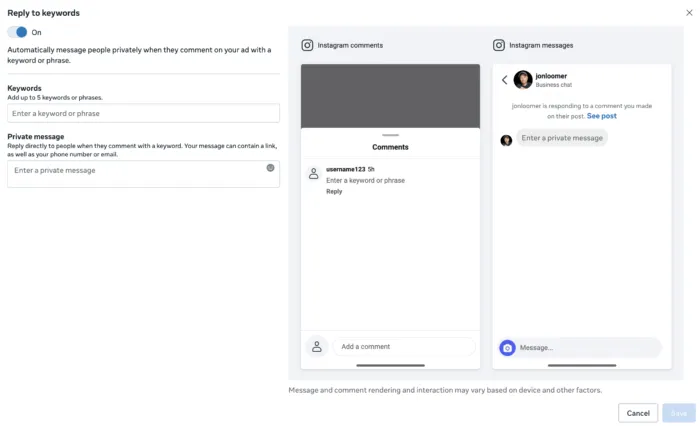
Those with access can turn on Reply to Keywords inside a new Conversations section when creating an ad. Advertisers can define up to five keywords or phrases that will trigger an automatic private message.
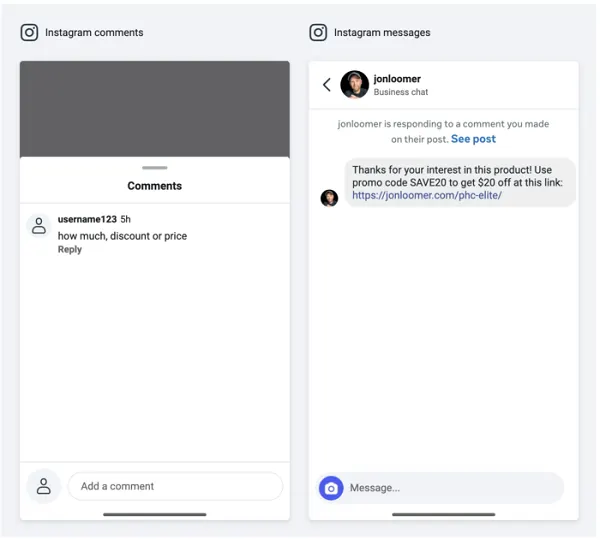
The message can include text, a link, a phone number or an email address. Meta also provides previews showing how the original Instagram comment and subsequent DM will appear.
According to Loomer, the current version appears to send the same message regardless of which selected keyword is used. That limits its usefulness for handling several different questions, but makes it well suited to a clear campaign instruction such as “Comment RECIPE and we’ll send it to you.”
The option currently appears to be limited to Instagram ads. Meta has not announced wider availability, supported markets or a rollout timeline, so advertisers should treat this as a limited test rather than a finished global product.
Why This Is More Than A Time-Saving Tool
Keyword automations are not entirely new. Businesses can already configure automated responses through Meta Business Suite, Meta’s messaging tools and approved third-party platforms.
The meaningful change is where Meta is putting the feature.
By placing Reply to Keywords directly inside the ad workflow, Meta is making private conversation part of the campaign itself. The comment is no longer simply engagement underneath the creative. It can become the first step in a lead journey.
That creates a compact conversion path:
See the ad. Comment a word. Receive the offer. Continue in private.
For campaigns built around guides, product details, discount codes, waitlists, menus, appointment information or event registration, that path may be more natural than sending someone through a landing page.
It also allows the ad to generate visible social proof while moving interested people into a less public environment. The comment creates momentum around the post. The DM creates space for the next action.
Meta Wants More Business To Happen In Messaging
The test also fits Meta’s wider investment in business messaging.
Meta says there are now more than one billion active threads with businesses across WhatsApp, Messenger and Instagram every day. The company is also expanding Meta Business Agent to Instagram, where AI can answer questions, recommend products, qualify leads, book appointments and support sales.
Reply to Keywords sits at the simpler end of that system. It does not need to understand a customer or generate an original answer. It only needs to recognize a predefined signal and deliver a predefined response.
That simplicity may be its biggest advantage.
A business does not need to train an AI agent or design an elaborate chatbot. It can build one clear exchange around one clear expression of interest.
The First DM Must Deliver The Promise
The strategic opportunity is not to automate more messages. It is to remove friction at the exact moment someone expresses interest.
That means the first DM should immediately deliver what the ad promised. If the call to action says “Comment MENU,” the message should contain the menu. It should not open with five qualifying questions or force the user through another funnel before providing it.
Advertisers should also use specific, intentional keywords. A generic word such as “price” or “yes” could be used naturally in a comment and trigger an unexpected message. A distinctive word connected to a clearly explained action creates a stronger sense of consent.
The best executions will:
- Tell people clearly that commenting will trigger a DM.
- Deliver the promised value in the first message.
- Give the recipient one obvious next step.
- Make it easy to reach a human when the conversation becomes more complex.
- Measure replies, qualified conversations and conversions, not only comment volume.
Meta’s existing developer rules for private replies limit an app to one private reply within seven days of the comment unless the recipient responds. Meta has not yet published separate documentation for this Ads Manager test, but advertisers should still design the first message as if it is their only guaranteed opportunity.
Where The Feature Could Go Wrong
The danger is that Reply to Keywords becomes another engagement hack.
An Instagram ad filled with hundreds of identical “GUIDE” comments may produce an impressive engagement number, but it does not automatically represent brand interest, qualified demand or cultural relevance.
There is also a difference between a requested response and an unexpected one. When the ad explicitly explains the exchange, the DM feels useful. When an ordinary comment quietly triggers a sales message, the same automation can feel intrusive.
A comment is a hand raise. It is not a blank check.
Brands will need to resist the temptation to treat every triggered DM as permission for an extended sales sequence. The feature will work best when automation handles the immediate delivery and people handle the conversation that follows.
What Marketers Should Watch Next
The current test leaves several important questions unanswered.
It is not yet clear whether Meta will allow different responses for different keywords, provide dedicated reporting for triggered conversations, optimize campaigns toward qualified replies, or connect the feature more deeply with Meta Business Agent.
Availability beyond Instagram is another open question. A version spanning Facebook, Instagram and potentially WhatsApp would turn keyword-triggered conversations into a much broader advertising layer.
For now, Reply to Keywords is a small feature with a very specific job. But it points toward a larger change in how social advertising works.
The ad is no longer only trying to earn attention or generate a click. It is trying to start a conversation, and increasingly, Meta wants that conversation to happen without anyone leaving its platforms.