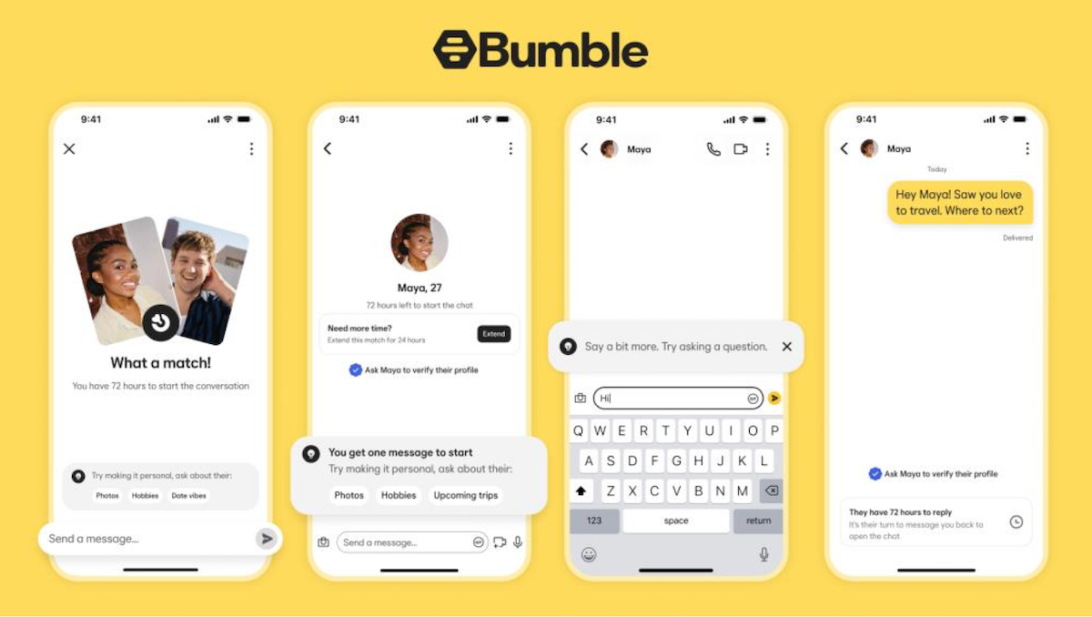
Bumble is taking apart the rule that made Bumble feel different in the first place.
The dating app announced it will now let anyone in a match send the first message. That means the women-message-first requirement, which has been central to Bumble’s positioning since its 2014 launch, is no longer the default mechanic holding heterosexual matches in place.
Bumble is also extending the response window from 24 hours to 72 hours. The idea is simple: less pressure, fewer missed matches, and a dating experience that does not demand constant app-checking just to keep a conversation alive.
Bumble’s Original Rule Has Become Too Heavy To Carry
For years, Bumble’s first-move rule was both a product feature and a brand thesis. It gave the app a clean distinction from Tinder and helped position Bumble as the more considerate, women-first alternative in online dating. Women decided whether the conversation began. Men waited. The mechanic was the message.
Now Bumble is reframing that same mission around flexibility rather than prescription. Whitney Wolfe Herd, Bumble’s founder and CEO, told TechCrunch that “women making the first move was a radical idea,” but that being women-first was “never about prescribing just one way to connect.”
The company’s own reported survey data suggests the old rule may no longer match how many users want to behave. According to TechCrunch, 66% of women surveyed by Bumble said they prefer men to send the first message, with many saying it would make dating feel less stressful. Bumble also says more than half of members surveyed felt the longer response window improved their experience.
That is the real shift here. Bumble is not just changing who can type first. It is admitting that empowerment, as a product mechanic, can start to feel like labor when the category around it changes.
Dating Apps Are Moving Away From Pressure Mechanics
This does not come from nowhere. Bumble had already started softening the original rule with features like Opening Moves, which let women set a prompt that men could answer. It also fits a broader reset inside the app: Bumble has already been moving away from the swipe as the center of dating behavior, trying to make the experience feel less like sorting content and more like starting something real.
The 72-hour window matters for the same reason. The old 24-hour countdown created urgency, but urgency is not always chemistry. In practice, it often rewarded people who were more available to the app, not necessarily more interested in the match.
Dating apps have spent years optimizing for speed: quick judgments, fast matches, instant replies, constant re-entry. Bumble’s update points in the opposite direction. It suggests that the next competitive edge may be less about forcing action and more about reducing the emotional admin that made users tired in the first place.
For Bumble, the risk is obvious. Removing the first-move rule makes the app less instantly recognizable. But keeping a famous mechanic just because it is famous is not strategy. If the behavior around dating has changed, the brand has to decide whether it wants to protect the slogan or protect the experience.
Bumble is choosing the experience. And in doing so, it is turning its most iconic rule into something more flexible, more conventional, and possibly more useful.
Also Read:
Aptoide Returns To Google Play As Android App Store Opens Up
Apple’s Camera AirPods Could Turn Siri Into A Visual Assistant
Cloudflare Launches Kitesurf, A Browser Built For AI Agents