


Bluesky is pushing Attie beyond custom feeds and toward something more ambitious: a way for ordinary users to build small social experiences without knowing how to code.
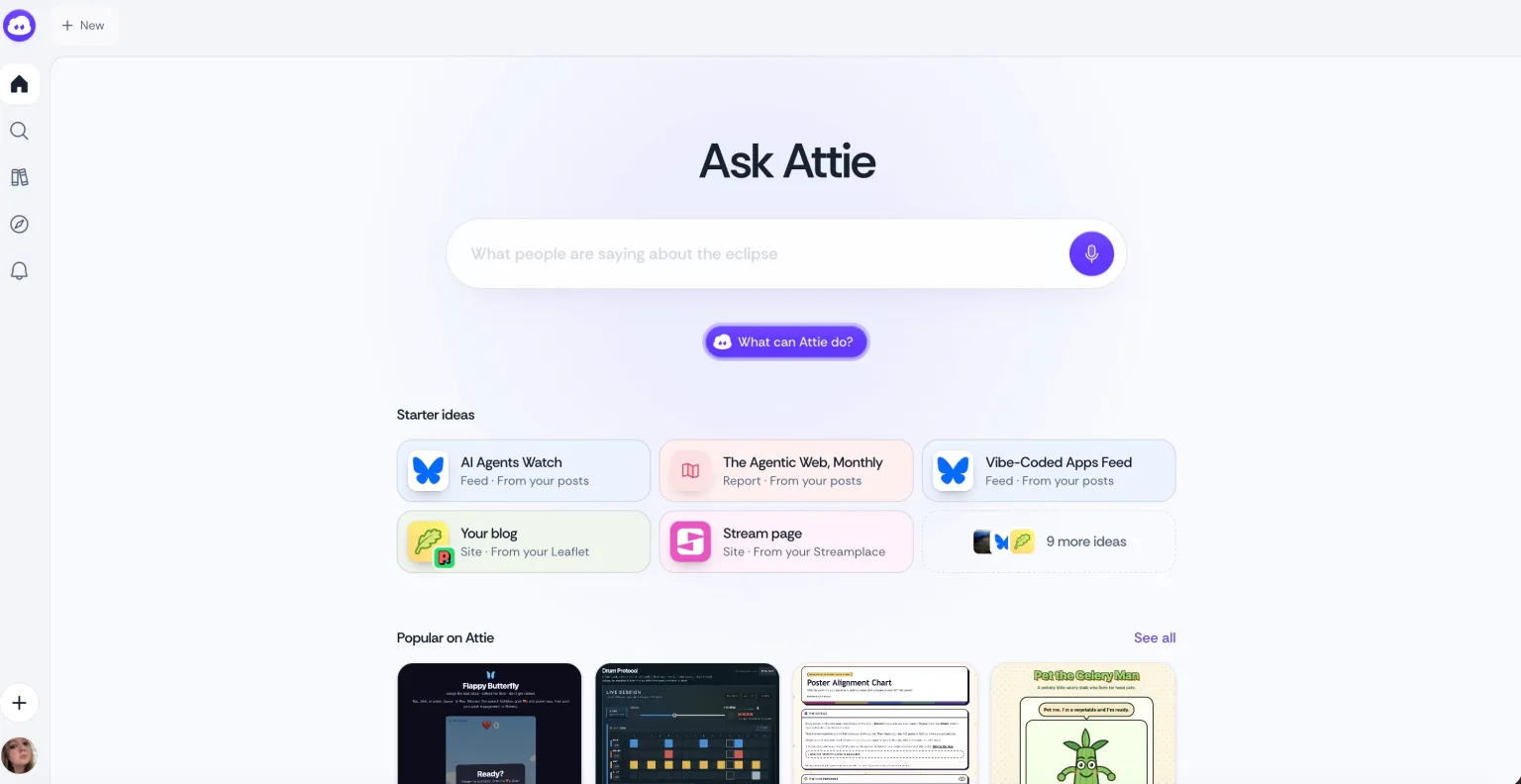
At TechCrunch Disrupt 2026, the company announced the Attie platform is expanding to let people create websites, quizzes, games, polls and other interactive experiences using AI. The report says those projects can live on the AT Protocol, the same underlying network used by Bluesky and other decentralized social apps.
Attie Is Moving From Personal Feeds To Shared Experiences
Attie originally positioned itself as an easier way to build custom social feeds. Its official introduction described the product as an invite-only experiment designed to make building on ATProto more accessible, with users describing the kind of feed they wanted in natural language.
The new direction changes the unit of creation. Instead of making a private tool for deciding what one person sees, users can create something intended for a group: a game for a community, a quiz around a shared interest or a small website that connects back to a social identity.
TechCrunch reports that creators will be connected to their ATProto identity and may receive suggestions based on their public Bluesky profiles. They can also bring their own AI model or use open-weight options. That keeps Attie close to Bluesky’s broader promise of an open network, while giving the company a more tangible reason for people to build there.
The Real Product Is Distribution
The sharpest detail in the announcement is not the ability to generate a website. It is the claim that these creations can reach Bluesky’s audience.
Bluesky COO Rose Wang framed the problem directly: people can already build things, but distribution remains difficult. Attie is meant to pair AI-assisted creation with an existing social graph, so a project does not have to begin as an isolated URL waiting to be discovered.
That is a meaningful shift in how social platforms think about participation. The feed is no longer the only product users can shape. The platform can become the place where communities make their own small formats, much like the AI creative workflows explored in Melius’s approach to AI creative workflows, then share them with people who already understand the context.
There is still a lot to prove. TechCrunch reports that Bluesky has around 47 million registered users but has also seen engagement soften, while support for private data on ATProto remains in alpha with a planned rollout by the end of 2026. Attie may help Bluesky create more reasons to return, but only if the experiences are useful enough to earn attention rather than simply producing more AI-made objects.
The strategic consequence is clear: Bluesky is trying to make its open protocol feel less like infrastructure and more like a place where communities can build together.