


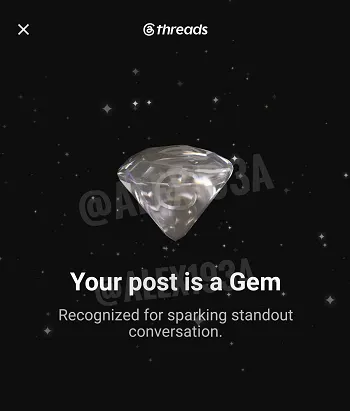
Threads is reportedly giving its best posts a new form of recognition. Called Gems, the feature identifies public posts and direct replies that Threads believes bring a fresh perspective, create genuine discussion and represent original work. The selected post receives a special icon in the feed, while its author can choose whether to share a separate post about the recognition.
That sounds like a small engagement feature. It is more interesting as a definition of what Threads wants its users to make.
Threads Is Defining the Conversation It Wants
The system evaluates three qualities: perspective, discussion and originality. A Gem should offer a fresh take, encourage real back-and-forth and be the creator’s own work. Crossposted content from another app is excluded.
The feature is also deliberately narrow. Gems apply only to public posts, while reply Gems are limited to direct replies to the original post. A reply to another reply does not qualify. That restriction keeps the recognition attached to the main public conversation rather than letting it spread through every layer of a thread.
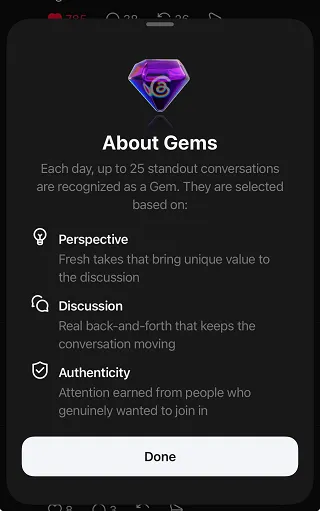
The important point is that Threads is not simply rewarding reach. It is trying to make a visible distinction between content that performs and content that gives the platform a reason to exist. The company has already described Threads as a place for “fresh perspectives” and highlighted the role of conversations and communities in its product direction. Gems turn that positioning into a product mechanic.
The Risk of Automating Taste
The selection process is reportedly systematic rather than based on human evaluation. That makes Gems scalable, but it also creates an obvious tension: the posts most likely to spark discussion are not always the posts a platform wants to celebrate.
A provocative claim, hostile exchange or misleading argument can generate plenty of replies. An algorithm looking for conversation may detect the activity before it understands the quality or consequences of the conversation. Recognition can then become a signal that rewards heat while claiming to reward value.
That matters because the Gem icon changes the meaning of engagement. It does not merely tell users that a post was popular. It tells them that Threads has judged the post worthy of attention. If the system works, the badge could help creators understand what the platform considers distinctive and give users a reason to participate in better discussions. If it fails, it could make controversial or low-quality exchanges look officially endorsed.
Threads has reportedly limited the initial program to users in the United States, leaving time to observe what kinds of posts receive recognition and whether creators actually want to display it. The option to decline a Gem is a useful detail. It acknowledges that platform approval is not always valuable to the person receiving it.
The broader move is clear. Threads is moving beyond giving creators a place to post and toward shaping the cultural signals around what deserves to be seen, shared and remembered. That makes Gems less important as a badge than as an editorial layer built into the feed.
For creators, the lesson is not to chase a new label. It is to understand that Threads is looking for original ideas that create sustained conversation, not just recycled distribution. For Meta, the harder task will be proving that an automated system can recognize meaningful discussion without turning provocation into prestige.