


The best version of an audio guide is the one you do not have to manage.
That is the idea behind Wrinkles, a new app for iOS and Android that uses your location to automatically surface stories about the places around you. The app works like an AI-powered audio tour guide, pulling up hidden history, local lore, and the stories behind nearby streets and buildings while you move through a place.
The promise is simple: stop turning discovery into phone admin.
An audio tour guide that starts with where you are
Wrinkles was founded by David Stemler, a longtime advertising executive, and Ryan Hansan, who previously founded ScratchDC, a meal delivery service, and TasteLab, a shared commercial kitchen for independent food businesses. The two have known each other since middle school, and travel has long been part of their friendship. That detail matters because Wrinkles feels less like a pure AI utility and more like a fix for a very familiar travel behavior: wanting context without losing the moment.
The spark came during a visit to the British Museum in London. Stemler was using the museum’s official app for a self-guided tour and found himself stuck in the classic tourist posture: head down, matching numbers on walls to items on his phone instead of looking at the objects in front of him. He later called Hansan from the airport with the question that became the product: if the phone already knows exactly where you are, why shouldn’t the places in front of you be able to speak?
That product framing is important. Wrinkles is not asking users to search for a landmark, scan a plaque, or plan a route. It is starting from location and letting the story find the user. The company has already built a global foundation of 1.3 million “Wrinkles,” or points of interest, across 177 countries. In other words, the app is not positioning itself as a museum companion. It wants to become a layer of context for everyday movement.
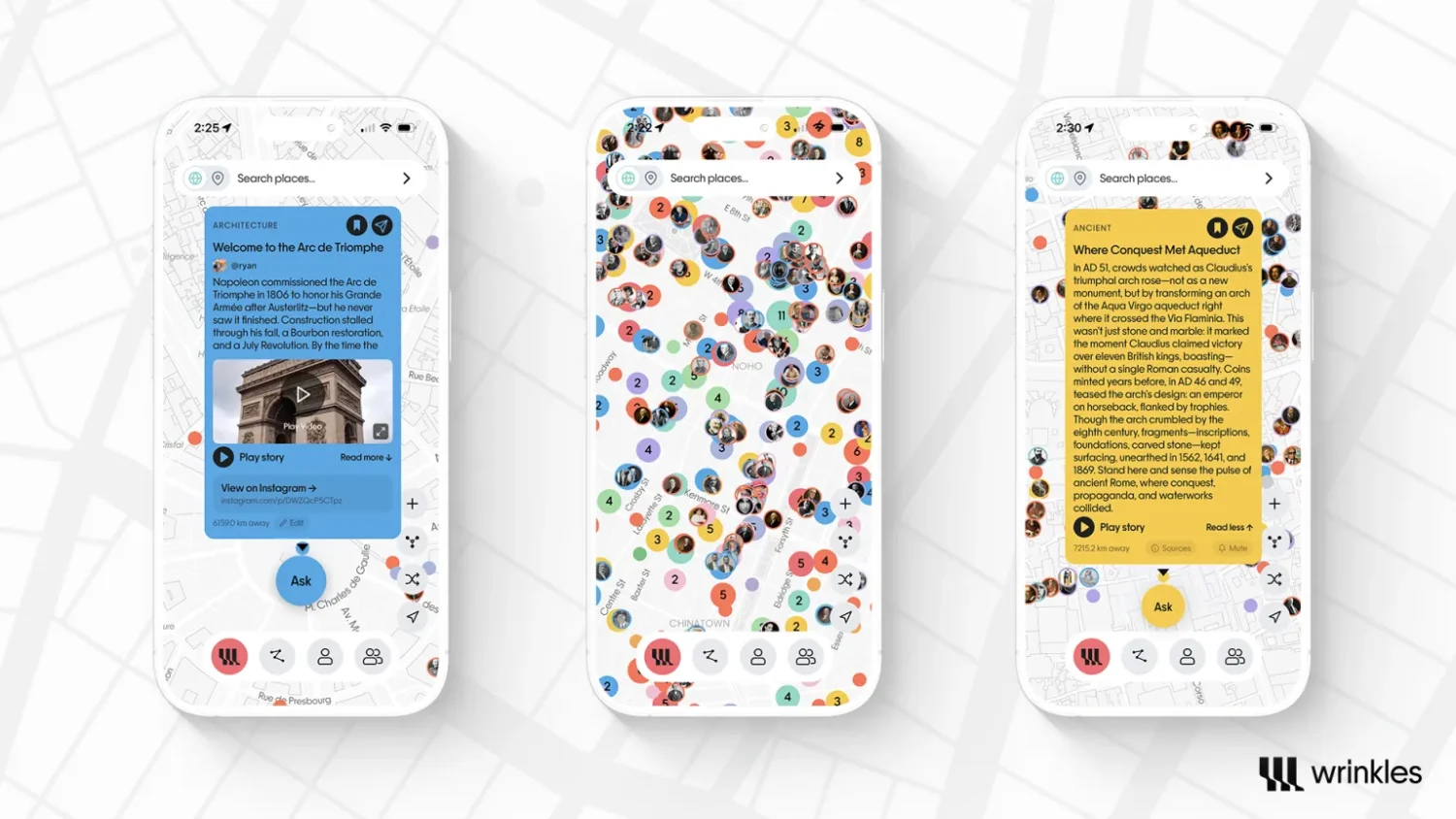
The interface moves from screen to surroundings
Wrinkles fits into a bigger shift in consumer tech: AI is becoming useful when it reduces the need to look, tap, filter, and decide. The app’s core behavior is not “ask a chatbot about this place.” It is closer to ambient discovery, where context arrives because the system understands where you are and what might be worth hearing.
That is why the audio part matters. A location-based story app could easily become another map full of pins. Wrinkles is trying to make the place itself feel like the interface. You walk, it narrates. You look around, it adds a layer. The phone stays in your pocket.
This is also where the product touches a much larger question for apps, wearables, and AI interfaces. The more technology tries to get out of the way, the more it has to prove that it deserves to be present in the background. We are already seeing that tension around future ambient devices, including the privacy questions surrounding Apple’s expected smart glasses. Wrinkles is a softer version of the same interface bet: technology that watches less like a feed and listens more like a guide.
For travelers, the appeal is obvious. For cities, museums, tourism boards, and local businesses, the opportunity is more subtle: stories can become discoverable at the exact moment people are physically near them. But the strategic consequence is bigger than tourism. If Wrinkles works, it suggests that the next useful AI interface may not be another box you type into. It may be the world around you, quietly made audible.