


Meta’s latest AI experiment is not another chatbot. It is a toy box.
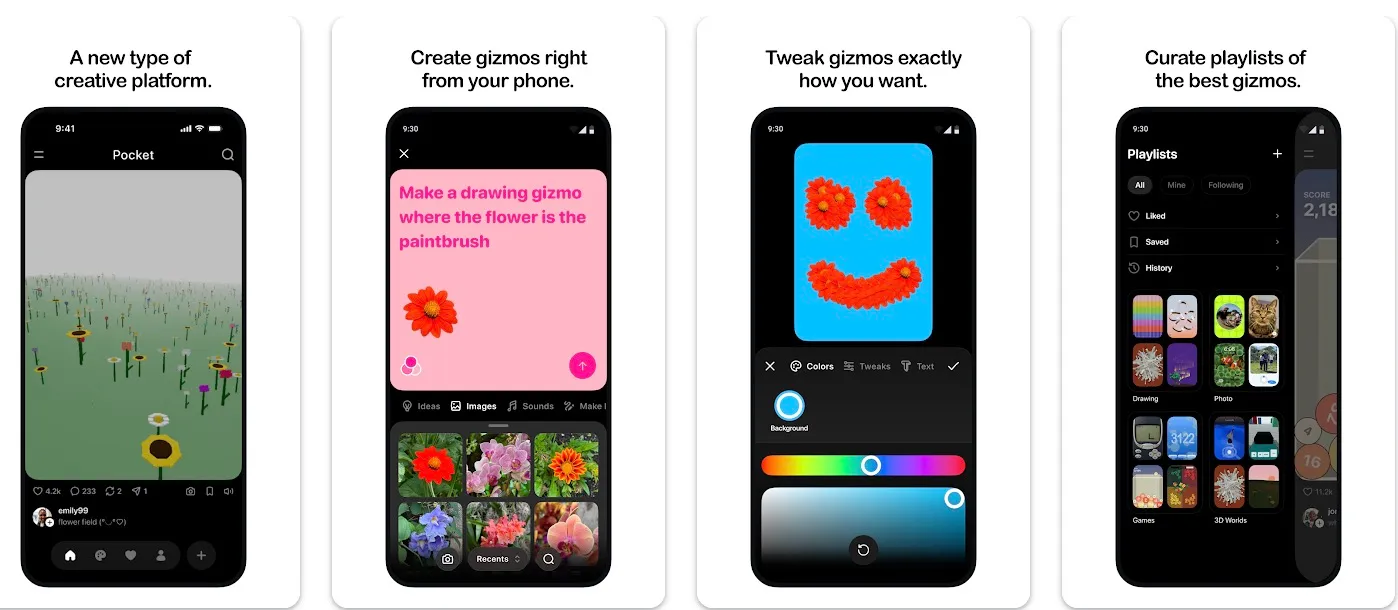
The company has quietly launched Pocket, a new app that lets people create and share small interactive games and app-like experiences using text prompts. The Google Play listing for Pocket describes it as “a creative platform for making and sharing gizmos,” with gizmos defined as small interactive things users can make simply by describing them.
That description matters. Pocket is not just asking people to generate an image, a caption, or a video clip. It is asking them to generate something that reacts.
The listing says gizmos can respond to touch and phone tilt, use sound, music, camera, and photos, and that some can even reason. It also includes a feed where users can discover and play with gizmos made by other people. In other words, Meta is testing whether AI creation can move from passive media into quick, social, playable objects.
Pocket appears to be the result of Meta’s acquisition earlier this year of the team behind Gizmo, a vibe-coded gaming platform. The original Gizmo app is still listed, and screenshots of Pocket show a similar mix of prompt-based creation and a discovery feed. Reverse engineer Alessandro Paluzzi first spotted the app’s launch publicly, while app intelligence firm Appfigures indicated that Pocket first appeared on the App Store and Google Play on June 29, 2026. Because the app is so new, Appfigures could not yet determine download activity. Meta has not commented on the launch.
#Meta is working on a new app called Pocket 👀
ℹ️ A new creative platform to make and share gizmos. pic.twitter.com/zFjMU5jj1U
— Alessandro Paluzzi (@alex193a) July 2, 2026
Prompting becomes a play pattern
The interesting part of Pocket is not that Meta is “getting into gaming.” Meta has been around gaming for years, from Facebook games to VR. What is different here is the creation mechanic.
Pocket treats prompting as a way to make tiny interactive experiences, not just content assets. That puts it closer to the vibe-coding wave than to a traditional mobile game launch. The user does not open a development tool, build levels, or learn a game engine. They describe an idea and get something playable enough to share.
The feed is the other key detail. If Pocket were only a private creation tool, it would be another AI sandbox. By adding a scrollable surface where people can play what others have made, Meta is giving the format a social loop: make, publish, test, remix, discover. That loop is what turns an AI feature into a potential behavior.
It also lowers the stakes of “making software.” A gizmo does not need to become a polished app. It can be a joke, a challenge, a game mechanic, a visual toy, or a quick interactive response to a trend. That is much closer to how social creativity already works.
Meta is testing another shape for social AI
Pocket fits neatly into Meta’s broader AI push. The company has already pushed AI image generation through Meta AI, experimented with AI video through Vibes, and added AI features across its creator tools, including Edits. Pocket extends that logic into interaction.
That does not mean Pocket is ready to become a major platform. The quiet launch, the lack of a formal announcement, and the absence of early download signals all point to an experiment. But the direction is clear: Meta is trying to find consumer AI formats that are social by default, not just useful on command.
For creators and brands, the immediate opportunity is not to rush into Pocket. It is to watch the behavior. If audiences start sharing lightweight interactive objects the way they share stickers, filters, Reels templates, or AI images, the creative unit changes. A campaign mechanic could be something people play with for ten seconds, not just watch for ten seconds.
That is the strategic consequence. If Pocket works, AI creation will not stop at content people post. It will become small pieces of software people scroll into.