


ChatGPT’s health ambitions are no longer boxed into a separate experiment.
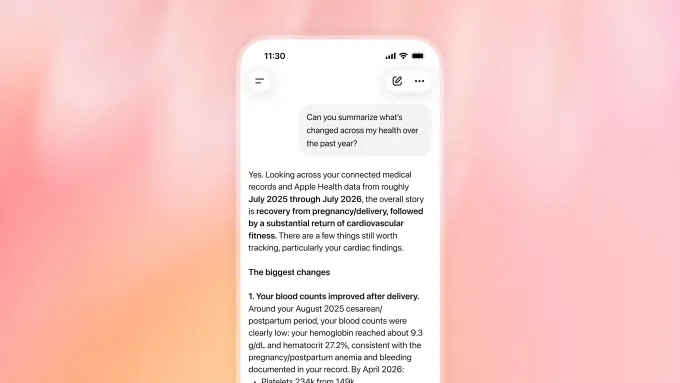
OpenAI is making ChatGPT Health available to all U.S.-based users over 18, across all plans. More importantly, it is letting personal health context move beyond a dedicated hub and into regular ChatGPT conversations.
That is the real shift. This is not just a new health tab. It is OpenAI testing whether health data can become part of the default assistant experience.
ChatGPT Health moves out of the hub
OpenAI first started testing ChatGPT Health in January through a dedicated hub, where users could connect personal information from services including Apple Health, Function, and MyFitnessPal. The rollout now expands that idea to all eligible U.S. users, while adding deeper connections to medical records from hospital systems such as Epic and Oracle Health, as well as health platforms including One Medical and Function Health.
Previously, users needed to go through the health hub for health-related queries. Now, they can choose to let ChatGPT draw on connected health information across general conversations. OpenAI’s example is simple: a user could ask about food or allergies in normal chat and have the assistant use their connected health context to make the answer more relevant.
The usage data explains why OpenAI is making that move. When the company started testing the feature, it said users were asking around 230 million health-related questions each week. That number has now climbed to 300 million. OpenAI also found that 70% of health-related queries during testing happened outside the dedicated hub.
That sentence says a lot. Users do not necessarily think in product tabs. They ask health questions where the question appears, inside the same assistant they already use for work, food, travel, parenting, fitness, and admin. OpenAI is now shaping the product around that behavior instead of trying to contain it.
The trust problem follows the feature
Health is also where the AI assistant promise becomes harder to separate from risk. The wider rollout comes just a day after a Florida-based pastor sued OpenAI, alleging the company gave a near-fatal suggestion not to consult a doctor. OpenAI, meanwhile, says it does not use user data to train its models and that it works with physicians to improve how its models respond to health-related queries.
The company is also pointing to model progress. TechCrunch notes that OpenAI says GPT-5.6-Luna, the smallest model from its latest release, outperforms GPT-5.5 on HealthBench, an open-source benchmark developed by OpenAI to evaluate large language models on health queries.
But benchmark gains do not erase the product tension. OpenAI’s own terms still say its services are “not intended for use in the diagnosis or treatment of any health condition.” That disclaimer matters more, not less, when the assistant is allowed to use personal health data in everyday chat.
This is becoming a familiar AI pattern: more personal context creates more useful answers, but it also raises the bar for control, transparency, and trust. We have already seen a version of that pressure in creator tools, with TikTok testing ways for creators to protect their likeness from AI doubles. In health, the stakes are even higher because the output can feel personal, authoritative, and urgent all at once.
For health, wellness, food, and fitness brands, the near-term implication is not simply that ChatGPT has another feature to watch. It is that assistants may increasingly mediate how people interpret personal data, symptoms, routines, and product choices before they ever search, scroll, or visit a brand-owned destination.
If ChatGPT Health works, the chatbot stops being a place where people ask health questions and becomes a layer that carries health context into everything else they ask.