


What to know
- OpenAI is removing limits on text-based ChatGPT chats for free users, with unlimited text chats arriving next week.
- Free and Go users will get GPT-5.6 Luna as the default model, replacing GPT-5.5, plus a new Think button for harder questions.
- Paid users are not being ignored: Plus and Pro subscribers get an upgraded GPT-5.6 Sol model and a thinking slider to tune how much reasoning the model applies.
ChatGPT’s biggest change this week is not a new prompt trick. It is the removal of the prompt meter.
OpenAI is bringing unlimited text-based chats to free users, a move that changes the psychology of using ChatGPT as much as it changes the product itself. The company recently crossed 1 billion weekly users, and at that scale, limits are not just technical controls. They are behavioral signals. They tell people when to experiment, when to hold back, and when to save the “good” question for later.
By removing text-chat limits, OpenAI is making the free version feel less like a trial and more like the default interface for everyday AI. That does not mean everything becomes unlimited. The company is keeping separate limits for files, images, voice, and image generation. But text is still the core behavior. It is where users ask, test, draft, compare, plan, and return.
That makes this a very deliberate unlock. OpenAI is not giving away every capability. It is making the most habitual one harder to ration.
The free tier stops feeling temporary
For Free and Go users, the experience will now be powered by GPT-5.6 Luna, which becomes the default model and replaces GPT-5.5. These users will also get a new Think button, designed for more complex questions that need higher reasoning power.
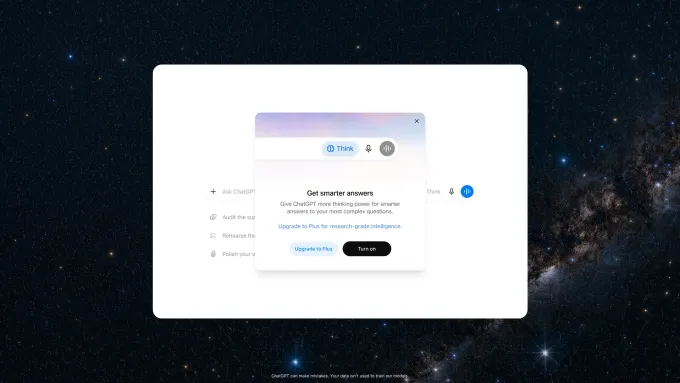
That combination matters. Unlimited text chats alone could have made ChatGPT feel more accessible, but pairing it with a visible reasoning control changes the relationship. Users are not only being told they can chat more. They are being taught that some questions deserve a different mode of thinking.
This is where the product starts to train behavior. The button gives people a simple mental model: fast conversation most of the time, deeper reasoning when the question gets harder. It turns model complexity into an interface choice instead of making users understand the model stack behind it.
OpenAI is also giving itself room to keep premium value intact. Files, images, voice, and image generation still have their own caps. Plus and Pro users are getting an upgraded GPT-5.6 Sol model, positioned for quick tasks like questions, web research, advice, planning, writing, and decision-making. OpenAI says this version will deliver more compact and robust answers, and it is separate from the GPT-5.6 Sol used for Codex and Work, which remains unchanged.
In other words, free users get more everyday access. Paid users get more precision, more speed, and more control. That is a cleaner split than simply selling more prompts.
Control is becoming the paid product
The most interesting paid feature may be the new thinking slider for Plus and Pro users. Instead of a single Think button, subscribers can adjust how much thought the model puts into an answer, based on the complexity and number of steps involved in the query.
This is a subtle but important shift. As AI tools become more mainstream, the premium layer is less about whether a user can access intelligence at all. It is about how much control they have over the behavior of that intelligence.
That same pattern is showing up across social and creator platforms, too. As AI becomes more present in public-facing tools, platforms are adding new controls around identity, trust, and output , like TikTok testing ways for creators to protect their likeness from AI doubles. The shared idea is simple: once AI becomes normal, the interface has to make it feel manageable.
OpenAI’s internal evaluation gives the company a quality argument as well. Compared with GPT-5.5-Instant, factual errors were 62% less common for GPT-5.6 Luna and 68% less common for GPT-5.6 Sol, according to the company. Those numbers do important positioning work. Unlimited access could easily raise concerns about more low-quality answers at greater volume. OpenAI is trying to frame the rollout as broader access to a better baseline, not just more usage.
The timing also creates a staggered upgrade path. Plus and Pro users get the updated GPT-5.6 Sol now. Free and Go changes arrive this week. Unlimited text chats and the new Think button follow next week. That lets OpenAI move paid users first, then expand the broader habit loop once the story is no longer just about subscribers.
The strategic consequence
ChatGPT is moving toward a model where basic conversation becomes table stakes. The text box is no longer the scarce product. The scarce product is confidence: better answers, adjustable reasoning, richer inputs, and the ability to decide how the system should behave.
That is a more mature version of consumer AI. Early AI products sold access to the magic. Now the biggest platforms are selling ways to shape the magic without breaking the illusion that anyone can use it.
For OpenAI, removing text limits is a growth move, but it is also a habit move. If free users stop counting prompts, they are more likely to make ChatGPT part of ordinary work, search, writing, planning, and decision-making. Once that happens, the upgrade question changes. Users are no longer paying because the free version ran out. They are paying because the free version became important enough to want more control over it.