


Bluesky has added a small control that says something big about social media fatigue: sometimes, users do not want more reach.
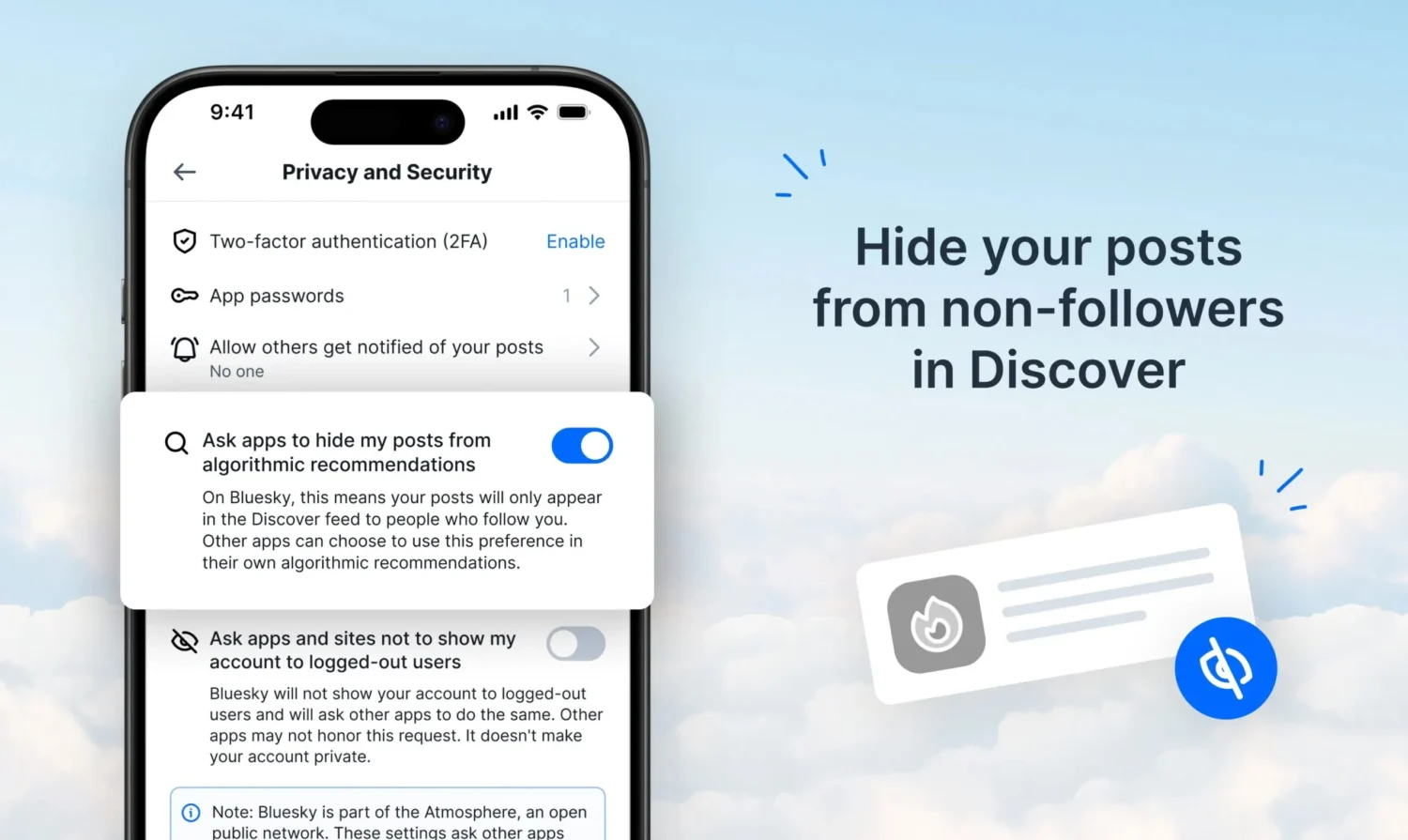
A new Bluesky feature that lets users opt out of the platform’s algorithmic Discover feed. In practical terms, that means a post can avoid being pushed toward people who do not already follow the account. It can still live on Bluesky, but it does not have to become platform fuel.
That distinction matters. Most social platforms have spent years making virality feel like the default prize. Bluesky is testing a different assumption: reach is not always a reward. Sometimes it is a risk, a burden, or simply not the point.
Reach is becoming a user control
The Discover feed is Bluesky’s algorithmic surface, the place where posts can travel beyond a user’s immediate follower graph. Opting out of that distribution gives people a softer alternative to locking down their entire presence. They can participate in public conversation without every post being treated as a candidate for algorithmic amplification.
That is a subtle but important product move. Social networks usually give users blunt privacy choices: public or private, visible or hidden, open or restricted. This sits somewhere in between. It separates publishing from promotion.
It also speaks to a very real behavior: people post for different audiences at different moments. A joke for mutuals, a thought for a niche community, or a quick reaction to a conversation does not always need to be served to strangers in the name of engagement. Accidental virality can bring attention, but it can also bring pile-ons, context collapse, and the exhausting feeling that a throwaway post has become a public performance.
Bluesky’s answer is not to make users post less. It is to give them more say over where a post travels. That is the part other platforms should be watching.
The quiet-post era is starting to make sense
This feature fits a broader shift in social product design: platforms are adding controls that shape who gets pulled into a piece of content, not just who can technically see it. We saw a different version of that logic when Threads joined Meta’s parental supervision stack, turning platform participation into something managed through more granular guardrails.
For Bluesky, the Discover opt-out is especially on-brand. The platform has built much of its identity around user choice, custom feeds, decentralization, and the idea that users should have more control over their social experience. Giving people a way to avoid algorithmic discovery extends that philosophy from what users consume to how their own posts are distributed.
There is a marketer lesson here, but it is not the usual “more reach is better” one. If users increasingly expect to control amplification, brands and creators will have to earn distribution more deliberately. The audience may still be public, but the permission to spread is becoming more conditional.
The smartest part of the feature is that it treats virality as optional infrastructure, not social destiny. That may be a small product detail. But it points to a platform future where posting and being amplified are finally treated as two different choices.