People are getting more comfortable giving AI access to their thoughts, plans and personal context. That does not mean they are comfortable giving the same access to advertisers.
Snapchat has published research based on a survey of more than 4,200 AI users conducted by Ipsos and WPP. The report’s central argument is blunt: privacy is becoming a value exchange, and users may accept data collection when the benefit feels immediate and personal.
AI is becoming useful in private moments
The research says 48% of consumers use AI daily, while 50% of creators and marketers describe it as a core part of their routine. Those figures point to a shift beyond experimentation. AI is increasingly being used as an everyday aid for thinking, communication and decision-making.
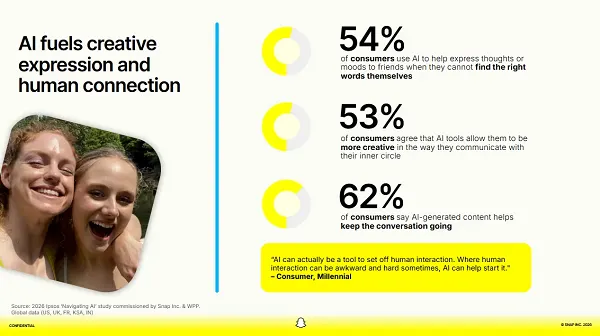
Some of the more revealing findings concern social behavior. Sixty-two percent of AI users said these tools help them maintain conversations. Snapchat users were 2.2 times more likely to agree that AI improves their social life and 1.6 times more likely to use it to plan real-world activities.
More than 80% reportedly describe AI as friendly and collaborative, while 74% see it as a judgment-free space for working through complex feelings before sharing them with other people. The important detail is where this trust appears: in private, useful interactions that help users articulate something or decide what to do next.
The privacy trade has a boundary
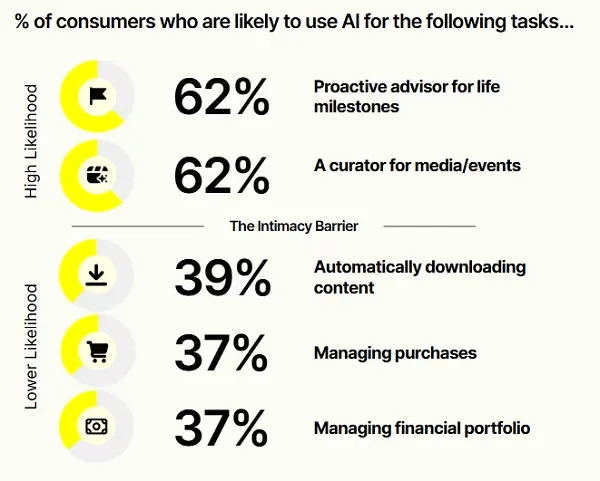
Snapchat frames this as a sliding scale. Users are not always asking whether an experience is private. They are asking whether it is worth the data involved.
That logic explains why people might share information with an assistant that helps them communicate, plan or make a choice. It does not automatically extend to advertising. The same report says 70% of consumers find personal data used in hyper-personalized AI ads intrusive, while 56% consider fully AI-generated content soulless.
That is the tension platforms and marketers need to take seriously. Utility can earn permission in a specific moment, but it does not create a blank cheque for every downstream use of the data. A user may trust an AI tool as a private coach and still reject the idea that the conversation should make an ad feel more personal.
For Snapchat, the strategic consequence is clear. AI adoption will depend less on promising that users have nothing to fear and more on making the exchange legible: what the tool does, what information it needs and what the user gets back. The closer the experience feels to private assistance, the more carefully platforms will need to separate usefulness from surveillance.
Also Read: