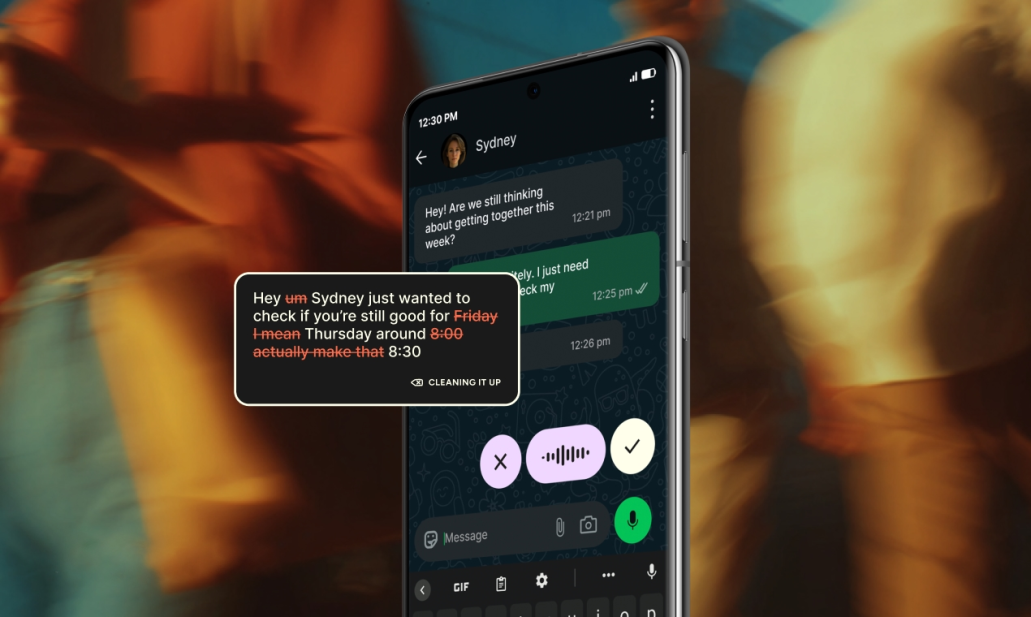
AI-powered dictation startup Wispr Flow has officially launched its Android app, marking a major step in its ambition to make voice the default input method on mobile.
After debuting on Mac and Windows, and rolling out on iOS in June 2025 via a dedicated keyboard, Wispr Flow is now bringing its voice-first experience to Android, but with a twist.
On iOS, users access Wispr Flow through a custom keyboard. On Android, the app takes advantage of the platform’s flexibility with a floating bubble interface. Users can simply hold the bubble to dictate in real time, tap once to start recording and press close to stop
The app works across other applications and doesn’t just transcribe speech. It removes filler words, cleans up phrasing, and formats text based on context, whether you’re writing a message, email, or document.
“Android finally gave us the freedom to build the voice experience we always wanted,” said Tanay Kothari, co-founder and CEO. “Only when the platform gets out of the way can we truly expect voice to replace typing on mobile.”
That quote says a lot. This isn’t just about transcription, it’s about rethinking input entirely.
Faster, Smarter, More Multilingual
Alongside the Android launch, Wispr Flow announced a full infrastructure rewrite, making dictation 30% faster than before.
The app now supports translation in over 100 languages and works system-wide across apps.
One of the most interesting updates? A dedicated model for Hinglish, the everyday blend of Hindi and English widely spoken in India. Rather than forcing users into traditional Hindi script, the new voice model transcribes mixed-language speech naturally. As Kothari explained, it’s built for people whose conversations fluidly move between English and Hindi, because that’s how real people speak.
“If you’re someone like me, English and Hindi weave together when I’m chatting with family and colleagues back home. This is one of those times when I just had to build something for me: the first voice model to actually support transcription in Hinglish instead of traditional Hindi script,” Kothari said.
It’s a subtle but culturally sharp move. AI that adapts to how people actually communicate, not how language textbooks say they should.
A Growing Category, But Few Android Players
AI dictation is crowded on desktop and iOS. On Android, though, the field is thinner. With this launch, Wispr Flow becomes one of the few serious AI-powered dictation apps available on the platform, alongside Typeless, which released its Android app last month.
Even in early rollout to select users, Wispr Flow reports that over 1.3 million words have already been spoken in English within just a few days.
That kind of engagement signals something bigger: users are not just testing voice, they’re using it.
Wispr Flow has quickly become one of the most talked-about startups in the AI dictation space. In June, it raised $30 million led by Menlo Ventures, followed by another $25 million round in November led by Notable Capital. In total, the company has raised $81 million, with its latest round reportedly valuing the startup at $700 million.
For years, voice input has been available on smartphones. But it never felt frictionless enough to replace typing. AI changes that equation.
Also Read:
Threads Now Lets You Share to Instagram Stories Without Leaving the App
ZIEA Introduces an AI Desk Companion Designed to Keep You Focused
Meta Leaves the Metaverse Behind as Horizon Worlds Goes Mobile-First