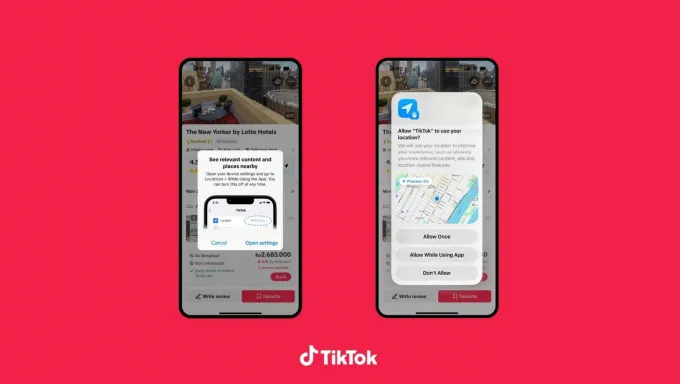
TikTok is rolling out a new “Local Feed” in the U.S., a dedicated stream of content tailored to users’ real-time location.
The feature surfaces nearby travel tips, local news, events, restaurants, shopping recommendations, and more, turning the app into something closer to a hyperlocal discovery engine.
But there’s a catch: it’s powered by precise location data.
Why TikTok Now Wants Your Exact Location
The launch follows a recent update to TikTok’s U.S. terms of service under its new joint venture structure, which included language about collecting more accurate location information. The company now confirms that this data collection is directly tied to enabling the Local Feed.
Importantly, the feature is opt-in.
By default, precise location sharing is set to off. The first time users access the Local Feed, they’ll see a permission request asking whether TikTok can use their location, either once, while using the app, or not at all. The feature is also limited to users 18 and older and only collects data while the app is active.
TikTok says this mirrors how many modern apps use location services, giving users control while enabling more relevant local experiences.
From Global Virality to Neighborhood Relevance
The Local Feed first launched in select European markets, including the U.K., France, Italy, and Germany, back in December. Now, it’s making its way to the U.S. with a clear positioning shift: TikTok isn’t just where culture happens globally; it’s where it happens locally.
Posts in the feed are ranked based on:
- A user’s current location
- The content’s topic
- Recency
That makes it a more real-time, community-driven stream, less “For You,” more “For Here.”
A Strategic Move for Small Business
This isn’t just about utility. It’s about positioning.
TikTok has been steadily strengthening its case as an economic engine for small businesses. According to a 2025 Oxford Economics report cited by the company, 7.5 million businesses use TikTok globally, supporting more than 28 million workers. Additional data from the Small Business & Entrepreneurship Council shows:
- 84% of TikTok small business users say the platform helped grow their business
- 75% say it helped them reach customers beyond their local area
- 74% say it helps them connect with their local community
The Local Feed brings that full circle, potentially driving foot traffic and real-world sales to brick-and-mortar stores across the U.S.
And strategically, this strengthens TikTok’s argument in ongoing regulatory conversations: like Meta, it can now point to tangible economic impact at the local level.
Convenience vs. Privacy
Still, the rollout timing raises questions. Had the request for precise location data coincided more clearly with the feature’s announcement, or preceded the U.S. ownership transition, the reception may have felt different. Instead, the Local Feed arrives in the shadow of increased scrutiny.
So the trade-off becomes clear: Is hyperlocal relevance worth the added data exposure?
For users, the answer will likely depend on how much they value discovering the next restaurant opening down the block, versus how much they want to keep their digital footprint minimal.
For brands and local businesses, though, this is something else entirely: A new battleground for attention.
Also Read:
Threads Users Get Direct Control of Their Feed With “Dear Algo”
TikTok Alternative Skylight Surges Past 380,000 Users
TikTok Quietly Launches A Micro-Drama App Called PineDrama