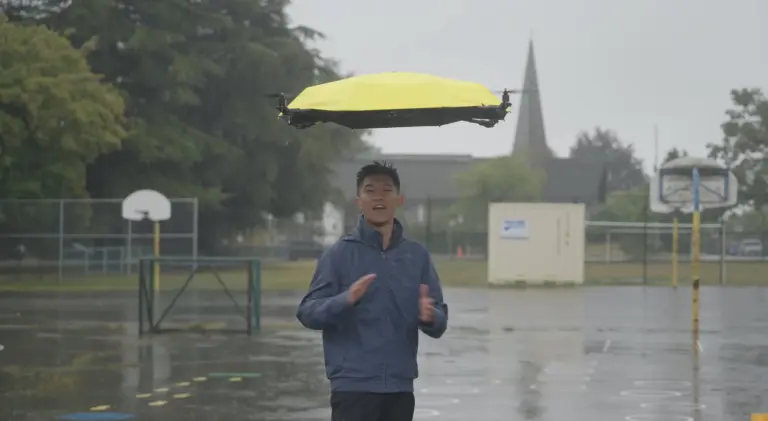
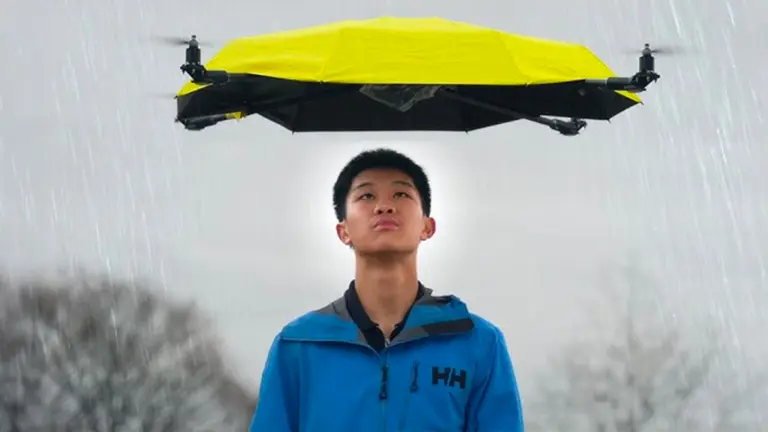
Holding an umbrella is one of those gestures so ingrained in daily life that we never really question it. And yet.
John Tse, the creator behind the I Build Stuff project, asked a deceptively simple question: why should we still have to hold an umbrella in 2026?
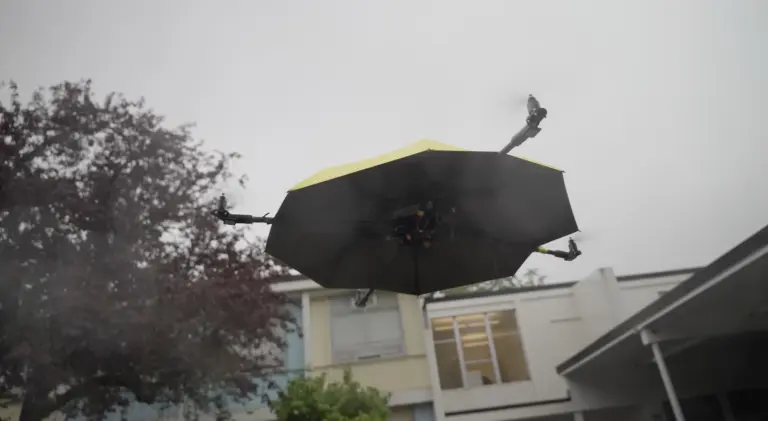
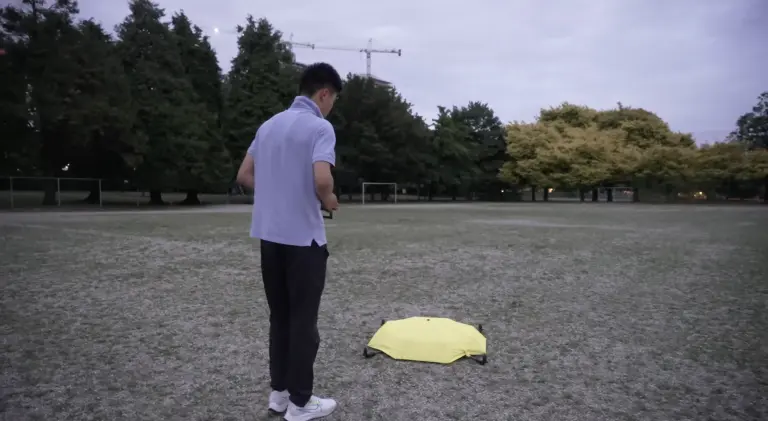
His answer comes in the form of an object that’s equal parts absurd and fascinating: a fully autonomous flying umbrella that follows its user, shielding them from rain or sun without any manual effort. Somewhere between a drone, a household object, and a piece of DIY sci-fi, the project is playful, but surprisingly rigorous.
A drone disguised as an umbrella
At first glance, the object looks reassuringly familiar. A bright yellow canopy. A classic umbrella silhouette. Nothing that screams “advanced robotics.”
Look closer, though, and the illusion breaks. Hidden beneath the fabric is a quadcopter system: four propellers integrated into a custom internal structure that allows the umbrella to lift off and hover above its owner.
The real challenge wasn’t making it fly, it was making it fly without breaking the idea of an umbrella. Mounting motors on the central shaft would have made the whole thing too heavy and awkward. Instead, Tse designed foldable arms that deploy when the umbrella opens and lock firmly into place for flight.
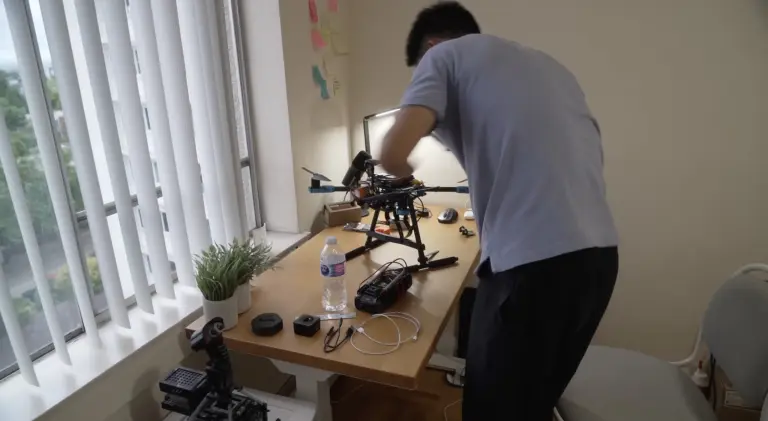
Hinges, custom plates, elastic elements, and a mix of off-the-shelf and 3D-printed parts work together to reduce vibrations and keep the canopy stable in the air. It’s clearly a prototype, but a remarkably functional one.
An umbrella that knows where you are
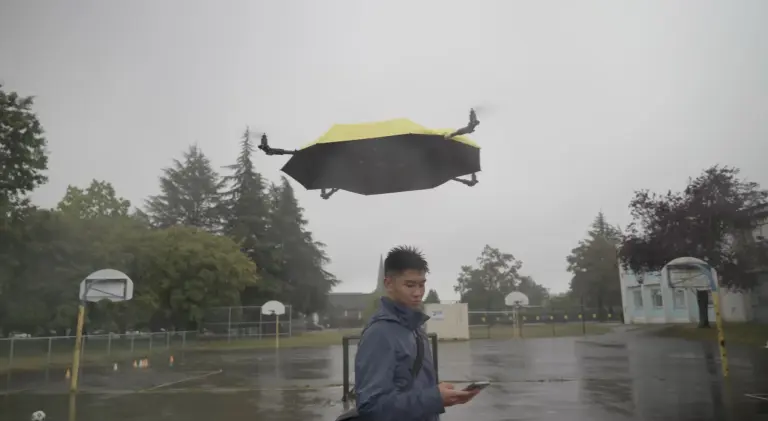
The real innovation isn’t the flying part, it’s the autonomy. From the start, Tse’s goal was to eliminate manual control entirely. The umbrella had to know where you are and adjust itself accordingly.
Early experiments with standard cameras and GPS proved unreliable. The breakthrough came with a time-of-flight depth camera, capable of detecting a person’s position in three dimensions, even in low-light conditions.
A Raspberry Pi processes this depth data to identify the user’s head, then sends commands to the flight controller to keep the umbrella centered overhead. As the person walks, the umbrella continuously corrects its position, hovering and tracking in real time.
Behind the polished demo lies a long trail of failed attempts. Broken parts, unstable software, fried components, crashes during testing — the project took nearly a full year of trial and error to reach a working version.
Most of the structural elements were 3D-printed, including parts made from carbon-fiber-reinforced nylon to balance strength and weight. Inside, the umbrella houses a professional-grade flight controller, GPS for outdoor positioning, and all the electronics needed to remain stable, even in wet conditions.
The result isn’t perfect. It can handle steady rain, but strong wind remains a problem. And it’s not meant to be a commercial product. It won’t replace traditional umbrellas anytime soon. Which is precisely what makes it interesting.
Also Read:
JCPenney Lets You Trade Your Ex’s Jewelry for a New Diamond Necklace
Heinz Introduces 114-ounce KegChup Barrel for the Super Bowl
Domino’s Turns Its Pizza Bags Into Winter Boots That Keep Your Feet Warm