


The AI race is still full of big benchmark claims. But Claude Opus 5 shows how the competition is becoming much more practical: better coding, familiar pricing, and performance comparisons that are increasingly about specific jobs, not just general intelligence bragging rights.
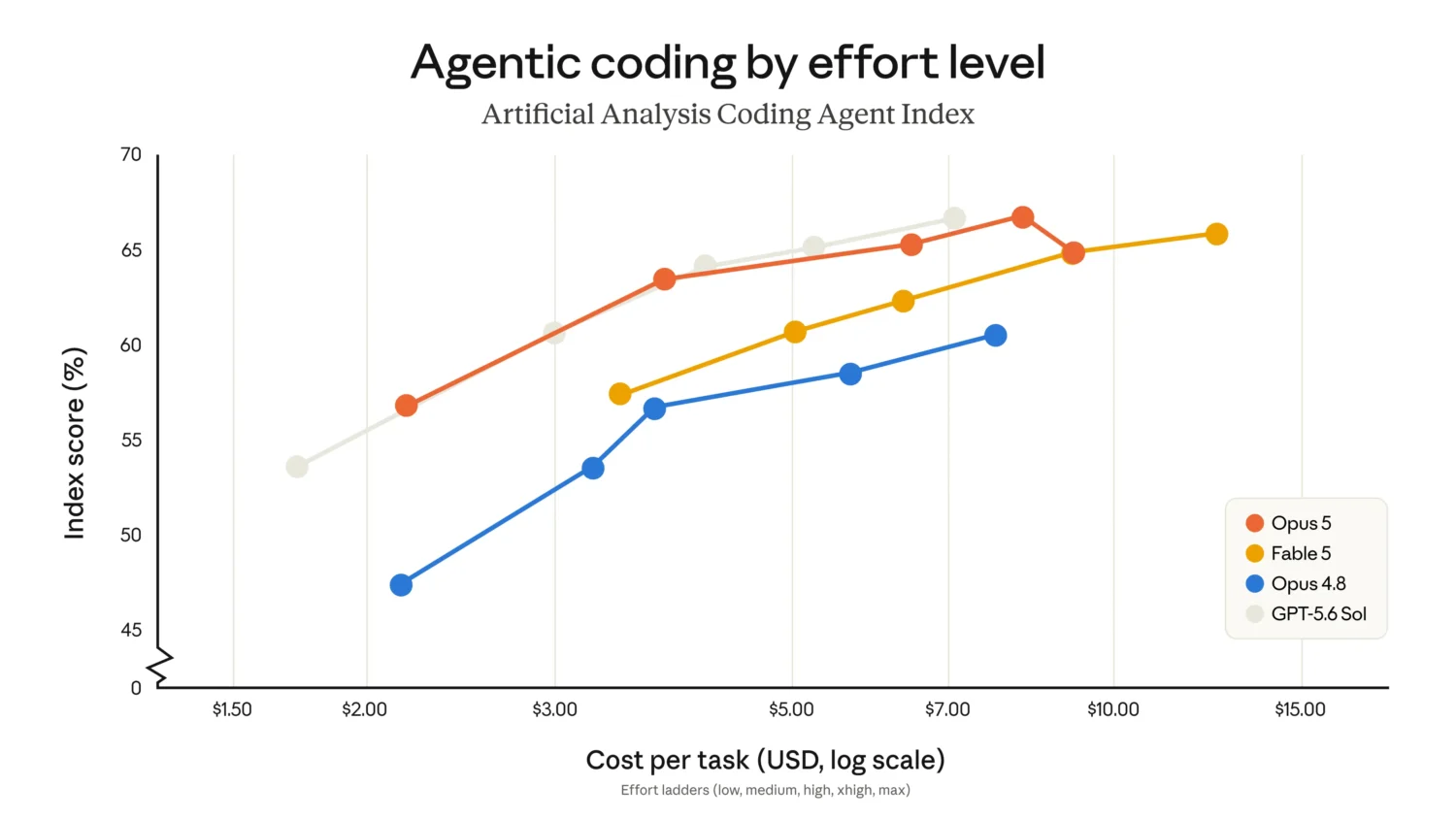
Anthropic has launched Claude Opus 5, positioning the new model as a stronger coding tool and saying it can rival Fable 5 in some tasks. The company is also keeping the API price the same as Claude Opus 4.8, which matters because model upgrades usually become harder to adopt when they arrive with a new cost calculation attached.
The upgrade is being sold through work, not wonder
The concrete pitch is clear. Claude Opus 5 brings major coding improvements, keeps the same API pricing as Opus 4.8, and, in some tests, gets close to Fable 5. That last point is important because it narrows the comparison. Anthropic is not simply saying the model is “smarter.” It is saying the model is competitive in particular tasks where developers and teams can actually measure the difference.
That is where the AI conversation is moving. The most useful model is not always the one with the loudest launch. It is the one that can be dropped into a workflow without forcing teams to rebuild budgets, prompts, tooling, and expectations every time a new version arrives.
In that sense, keeping Opus 5 at the same API price as Opus 4.8 may be as strategically meaningful as the coding gains. For developers, startups, and enterprise teams already experimenting with Anthropic’s models, price continuity lowers the friction. It makes the upgrade feel less like a new bet and more like a stronger version of the tool they were already using.
That mirrors a broader product shift we keep seeing: mature platforms are starting to win by fitting into real behavior, not by asking users to admire the roadmap. It is the same kind of product logic behind updates built around everyday habits, from messaging features designed for how people actually communicate to AI models sold on the work they can complete. WhatsApp’s recent feature push around real-life habits is a useful reminder that practical usefulness is becoming the cleaner story.
The benchmark war is becoming a workflow war
Claude Opus 5 also shows the new pressure on AI companies. It is no longer enough to claim a model is powerful in the abstract. Teams want to know where it wins, where it is merely close, and whether switching or upgrading is worth the effort.
Anthropic’s comparison to Fable 5 in some tasks is careful, and it should be read that way. “Some tasks” is not a universal victory lap. But it is still a meaningful signal. The model market is becoming more segmented, with different systems competing for specific jobs: coding, agentic workflows, reasoning, writing, research, customer support, internal automation.
For brands and marketers, the takeaway is not that every team needs to chase the newest model. It is that AI adoption will increasingly be judged by fit. The smarter question is not “which model is best?” but “which model is best for the task, the budget, and the existing workflow?”
Claude Opus 5 lands in that more sober phase of the AI race. The launch still has the usual competitive framing, but the real story is quieter: performance gains are becoming valuable when they arrive with less disruption. That is where AI moves from spectacle into infrastructure.