


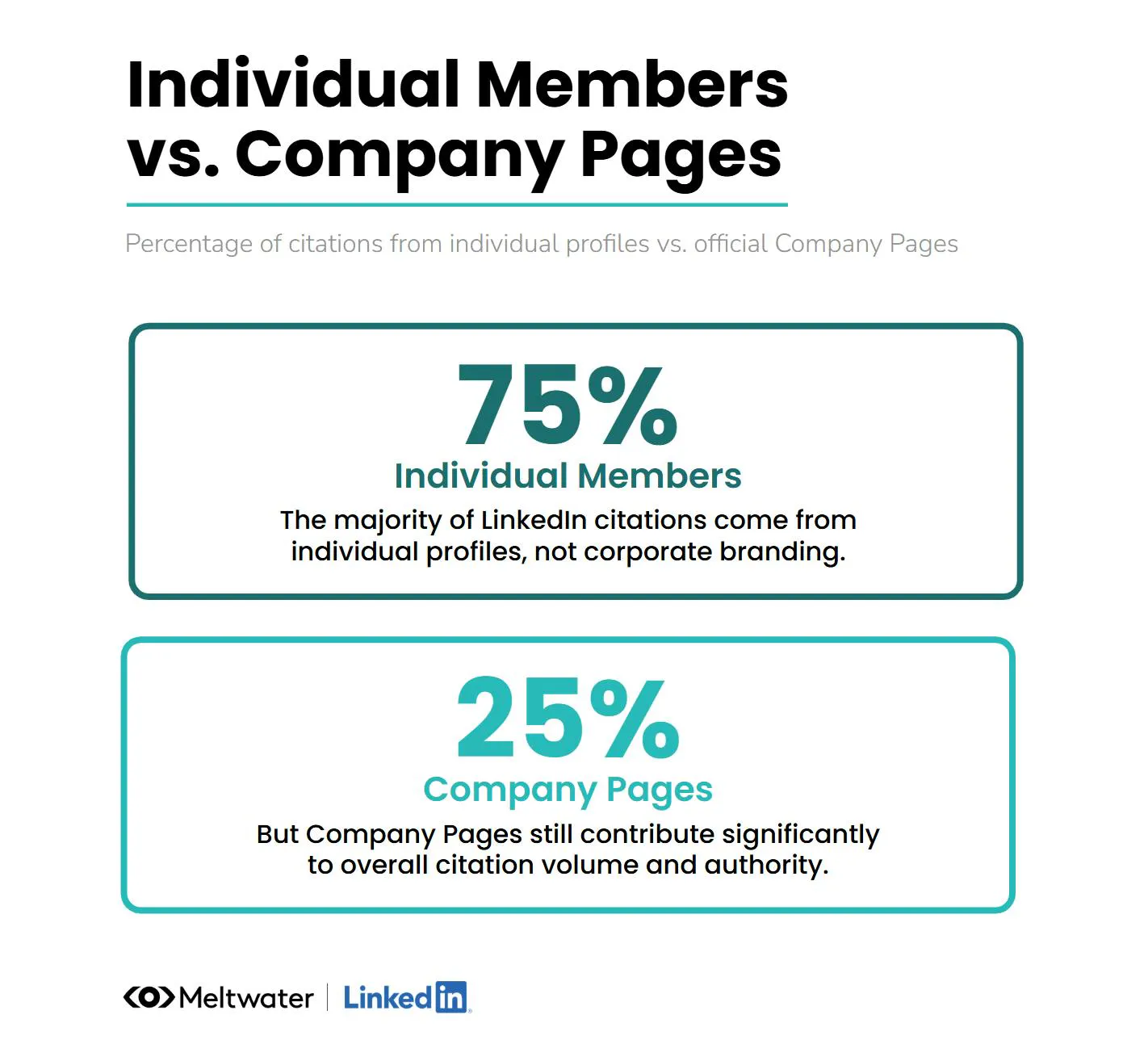
The headline is almost too neat: 75% of LinkedIn citations found in AI-generated answers came from individual members, while only 25% came from Company Pages.
The figure comes from research by Meltwater and LinkedIn. Meltwater says it analyzed 9.5 million citations across six AI platforms and thousands of prompts spanning major B2B categories.
The immediate lesson appears to be simple: people beat brands. But that reading is too shallow. The more useful implication is that professional authority is becoming distributed across the people inside an organization.
The Person Is Becoming The Source
We have already seen LinkedIn turn posting into an AI visibility game. This research adds a more human dimension to that shift.
LinkedIn content does not float around the web anonymously. A post is attached to a professional identity, a role, an employer, an industry and a visible history of activity. Meltwater argues that these signals, combined with specific examples and data, can help AI systems identify useful expertise.
That does not mean an AI assistant trusts a person in the way another person might. It means a retrieval system can connect a clear answer to a named practitioner with relevant context. When someone explains a problem they have actually worked on, that content can offer more usable evidence than a polished Company Page post built around approved claims.
This is not about training an AI model with every LinkedIn update. It is about becoming part of the public source layer that AI search products retrieve, summarize and cite when answering a question.
For brands, that changes the strategic value of employee expertise. Your people are no longer only a distribution network for corporate messaging. They are becoming part of the brand’s discoverability infrastructure.
Employee Advocacy Needs An Editorial Model
The traditional employee advocacy model starts with company content. A communications team publishes a post, then asks employees to share it. The company creates the message and the individual supplies additional reach.
The emerging model reverses that logic. It starts with the questions customers, peers and AI users are asking. The organization then identifies the people with real experience of those questions and helps them turn what they know into useful public source material.
That requires more than handing everyone a prompt template. Communications teams need to operate more like editors. They can map topic ownership, interview internal experts, surface original data, fact-check claims and help shape clear structures. The expert should still sound like the expert, not like the Company Page wearing a name badge.
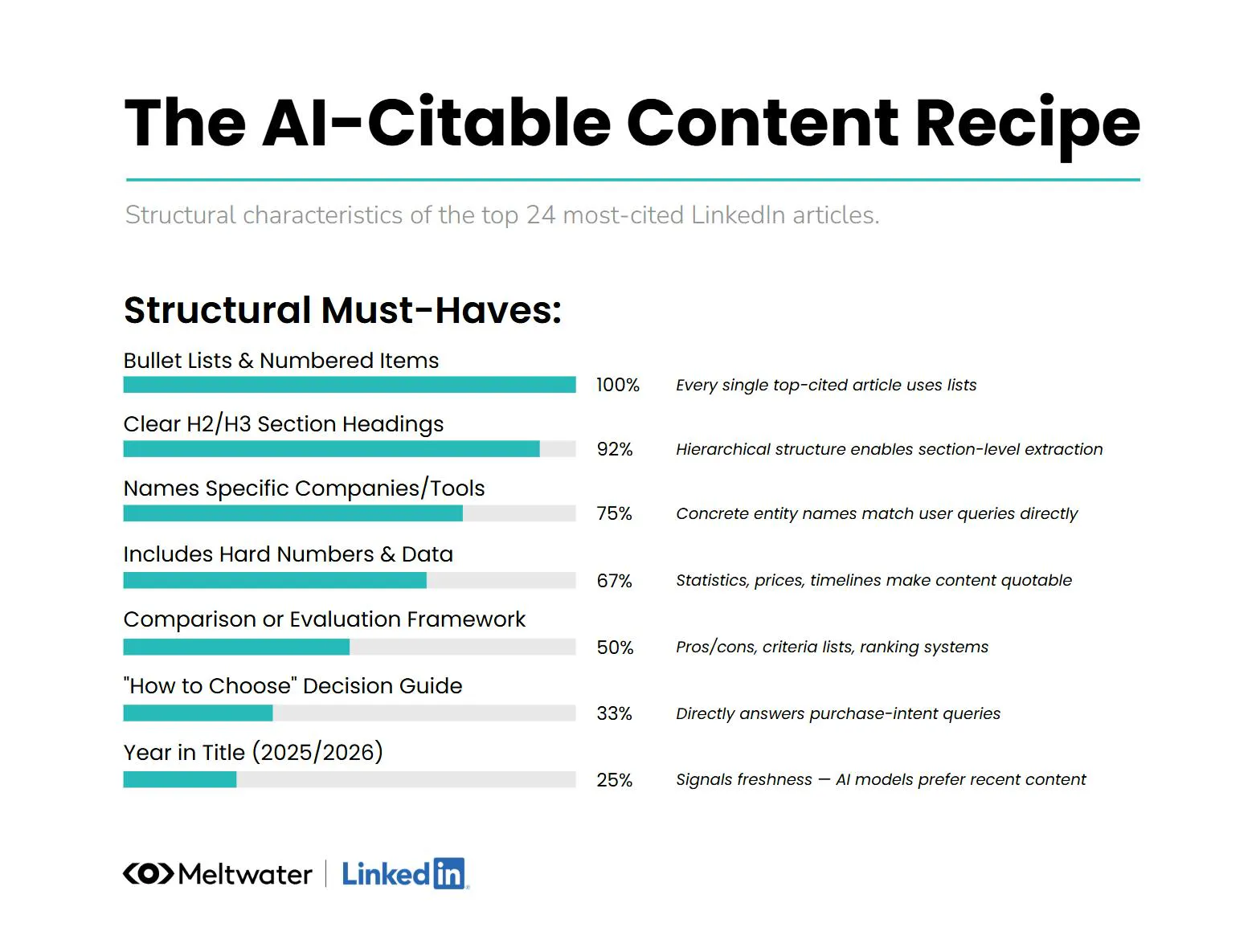
The research also found that the most-cited LinkedIn articles in its sample were highly structured. All used bullets or numbered lists, 92% used clear section headings and 67% included quantitative data. Decision-led formats such as comparisons and how-to-choose guides appeared more often than pure opinion.
There is an obvious trap here. If every professional starts writing for machine legibility, LinkedIn could fill with perfectly formatted content that says nothing. The goal is not to make employees sound like search results. It is to make what they know easier to find without sanding away the person who knows it.
One Number Should Not Become A Strategy
The 75% figure deserves context. It represents the share of LinkedIn citations found in this study, not the probability that any individual post will be cited. The published methodology does not show the relative volume of member content and Company Page content available to be selected, and the research was produced by two organizations with a commercial interest in LinkedIn and AI visibility.
A separate Semrush analysis of 89,000 cited LinkedIn URLs also found meaningful differences between systems. In its dataset, Perplexity cited Company Pages more often, while ChatGPT Search and Google AI Mode leaned toward individual creators. AI search is not one audience with one stable preference.
Citation is not the same as trust, attention, traffic or business impact either. A brand can be present in an answer without changing a decision.
Still, the direction is difficult to ignore. Original, useful and clearly attributed professional knowledge is becoming more discoverable beyond the feed. Brands should respond by building a visible bench of practitioners, not by manufacturing a new wave of executive influencers.
The next employee advocacy program should not ask people to distribute the company’s content. It should help them create the source material from which the company’s future authority will be built.
Culture moves through people. Increasingly, professional authority does too.