


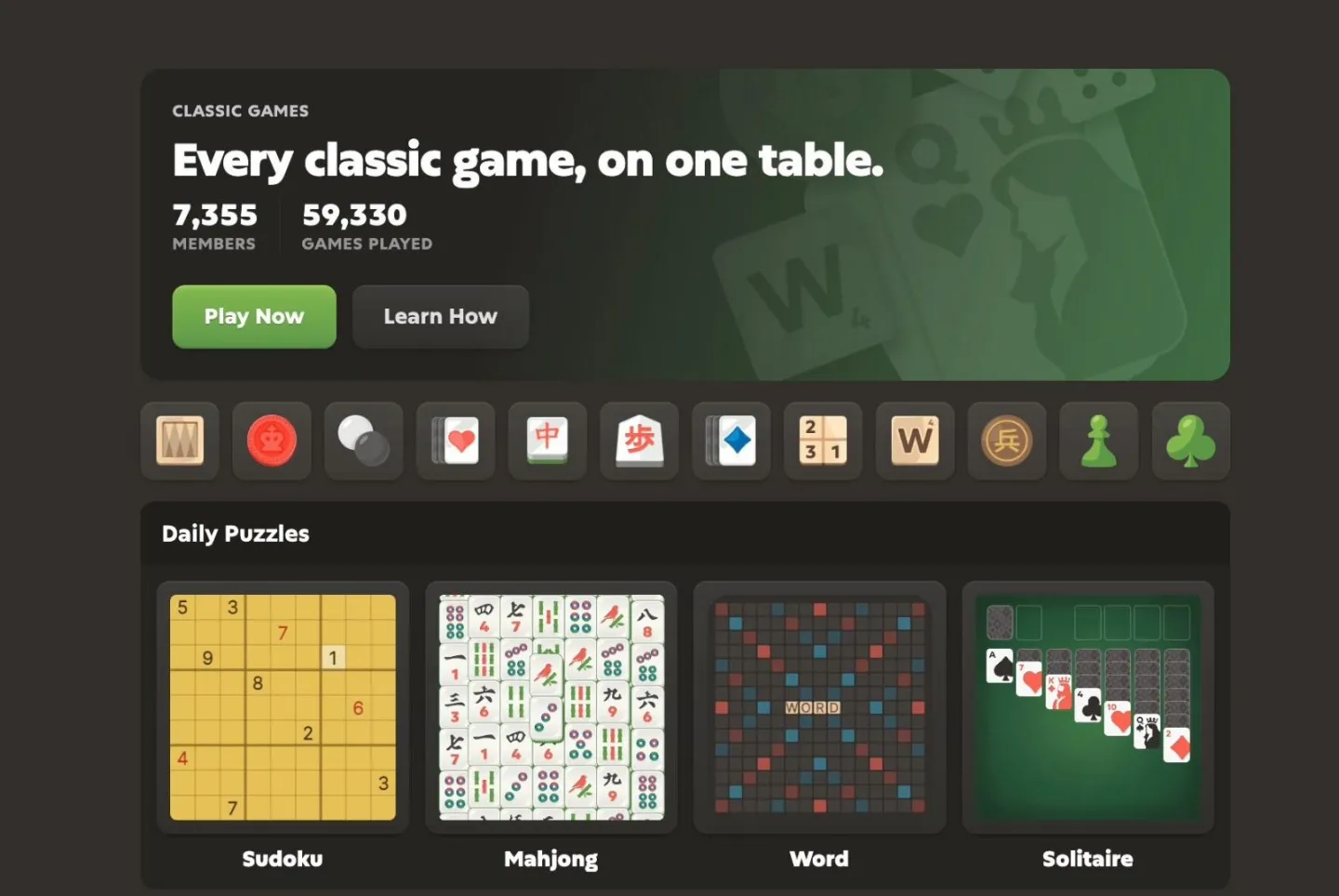
Chess.com is making a much bigger bet than its name suggests. The platform is preparing a public beta for Classic Games, a new hub that brings backgammon, checkers, go, hearts, mahjong, shogi, sudoku, solitaire, xiangqi, and a Scrabble alternative called Word into the same ecosystem.
The beta is expected to launch on the web and through new iOS and Android apps. The move is less about abandoning chess than applying the systems that made Chess.com large to games that do not yet have an equivalent home.
Chess.com is exporting its community model
Classic Games will borrow much of the product language that already works on Chess.com. Players will get lessons, leaderboards, ratings, multiplayer matches, bots, and familiar bot characters such as Martin. The experience will not be identical across every game. Word and mahjong will have puzzles, sudoku will offer daily grids, and solitaire will use daily deals.
That mix matters. Chess.com is not simply adding a collection of casual games to keep people inside an app. It is packaging different forms of play around a shared learning and community model. The company says it selected the games through community feedback, market research, and its belief that each one has a long learning journey and a community worth serving.
Chess.com says it has nearly 300 million members, and the strategic opportunity is clear. A player who arrives for chess might also have a reason to try go, mahjong, or sudoku without learning a completely new interface, rating logic, and social system from scratch.
AI is making the expansion possible
The more interesting part of the launch is how quickly it is being built. Albert Cheng, Chess.com’s chief growth officer, told The Verge that AI helped the team accelerate coding, using an approach similar to the one used to build Gambit, the company’s gambling-free poker product.
The new games sit on top of Chess.com’s existing code base, design system, bot characters, and rating systems. That gives a small team a meaningful head start. Cheng said fewer than 1 percent of the company is dedicated to building new games, while AI helps the team move faster as the underlying infrastructure is reused.
Chess.com also draws a line around where AI belongs. Cheng said it was not used for the art and design, which remain human-led. That distinction reflects a broader product reality: AI can compress the cost and time of building functional surfaces, but taste, interface judgment, and the feeling of a coherent community still determine whether those surfaces are worth returning to.
The immediate consequence is a broader games library. The larger one is that Chess.com is turning its accumulated community, content, and product systems into a repeatable launch platform. If Classic Games works, the company will not just have a successful chess product. It will have a faster way to create and connect entire categories of play.