


AI visibility may be becoming a reputation game before it becomes a content game.
LinkedIn is arguing that influential people are especially important if brands want to appear in answers from ChatGPT, Gemini, Copilot and other AI tools. The advice is notable because it shifts the focus away from simply formatting content for machines and toward the identity, history and network attached to the person publishing it.
But the evidence also comes with a large caveat: LinkedIn is using a developing search behavior to reinforce the value of being active on LinkedIn.
AI citations are being tied to people, not just pages
As Social Media Today reports, Robert Yanik, LinkedIn’s AI Search Marketing Lead, said AI models are built to reward credibility. In LinkedIn’s framing, credibility looks like a real person with a demonstrated track record, supported by a verified identity, employer history, skills and professional network.
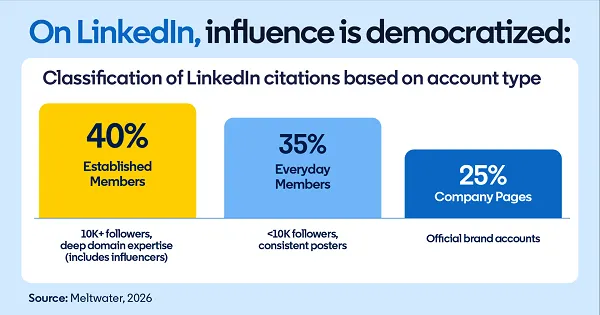
The figures cited by Yanik are designed to support that argument. Research from Meltwater reportedly found that individual LinkedIn users with more than 10,000 followers and company pages accounted for 65% of LinkedIn citations in AI chatbot responses. Users with fewer than 10,000 followers accounted for the remaining 35%.
Yanik also said C-suite and VP-level articles earned higher citation rates per article than non-executive content. That suggests the signal is not simply publishing volume. Title, company and industry information on a LinkedIn profile may help an AI system judge whether a source appears relevant or authoritative.
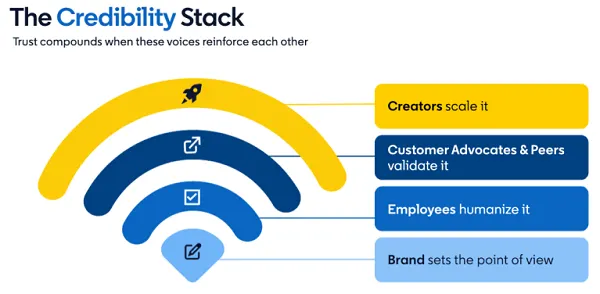
The practical recommendation is familiar, even if the framing is new: brands should identify three or four themes to own, activate credible employees around those themes, and consider partnerships with one or two creators whose audiences overlap with their buyers.
The useful signal is authority, but the proof is still incomplete
This is where the guidance becomes more interesting than the playbook. LinkedIn is describing a relationship between professional identity and AI citations, but it does not explain how ChatGPT, Gemini or Copilot actually make their source-selection decisions. Those systems do not necessarily use the same data, ranking logic or access to platform content.
That makes the findings directional rather than definitive. A large following may correlate with citations because it reflects authority, because popular posts are more visible, because LinkedIn has strong domain authority, or because several of those factors overlap. The number alone does not prove that an executive post is inherently more trustworthy than a specialist’s work from a smaller account.
It also explains why a formatting-first approach to answer engine optimization is unlikely to be enough. Clear structure can make information easier to interpret, but it cannot manufacture a track record. The more durable asset is a recognizable person whose expertise is consistently connected to a subject.
That is a meaningful shift for brands. Thought leadership is no longer only a distribution format or a way to humanize corporate messaging. It may become part of the source layer that AI systems use when deciding which voices to surface. The risk is that brands turn this into an executive-posting quota and produce a larger volume of predictable content. The opportunity is to build a smaller group of credible voices around subjects they can genuinely explain.
LinkedIn’s argument should therefore be treated as a signal, not a formula. AI citation strategies may reward established presence, but the platforms and models still need to show how those signals work before marketers can treat follower counts or job titles as reliable levers.