


Apple is working on a way to turn your Mac into a private AI server, without requiring you to know anything about coding or infrastructure.
Through its subsidiary Claris, the company is testing Harbor, a new application that lets Apple silicon Macs run AI models locally, keeping prompts and processing on the user’s own hardware rather than sending everything to the cloud.
The app surfaced in a Mac App Store listing on November 10 before disappearing later that day. Harbor is currently in private preview, with no public release date or confirmed pricing.
But the ambition is already clear: make running your own AI as easy as installing an app.
Apple has taken down Harbor from the App Store now
https://t.co/VwaZKwTYzd https://t.co/gvY2nPE6n1
— Aaron (@aaronp613) November 10, 2026
Your Mac becomes the AI server
Today, most people interact with AI through cloud services such as ChatGPT or Claude. Their requests travel to remote servers, where the models run before returning an answer.
Harbor offers a different approach.
Users will be able to browse, download and run open-weight AI models directly on their Macs. The app handles model management and setup, removing much of the technical complexity normally associated with running local AI.
One early screenshot even shows Harbor downloading OpenAI’s gpt-oss-20b model from Hugging Face.
Because processing happens locally, users won’t need to pay per-token inference fees to a cloud provider. More importantly, their prompts and private information won’t need to leave their own machines.
Of course, running powerful AI models requires powerful hardware. That’s where Harbor introduces another interesting capability.
Multiple Macs, one powerful AI system
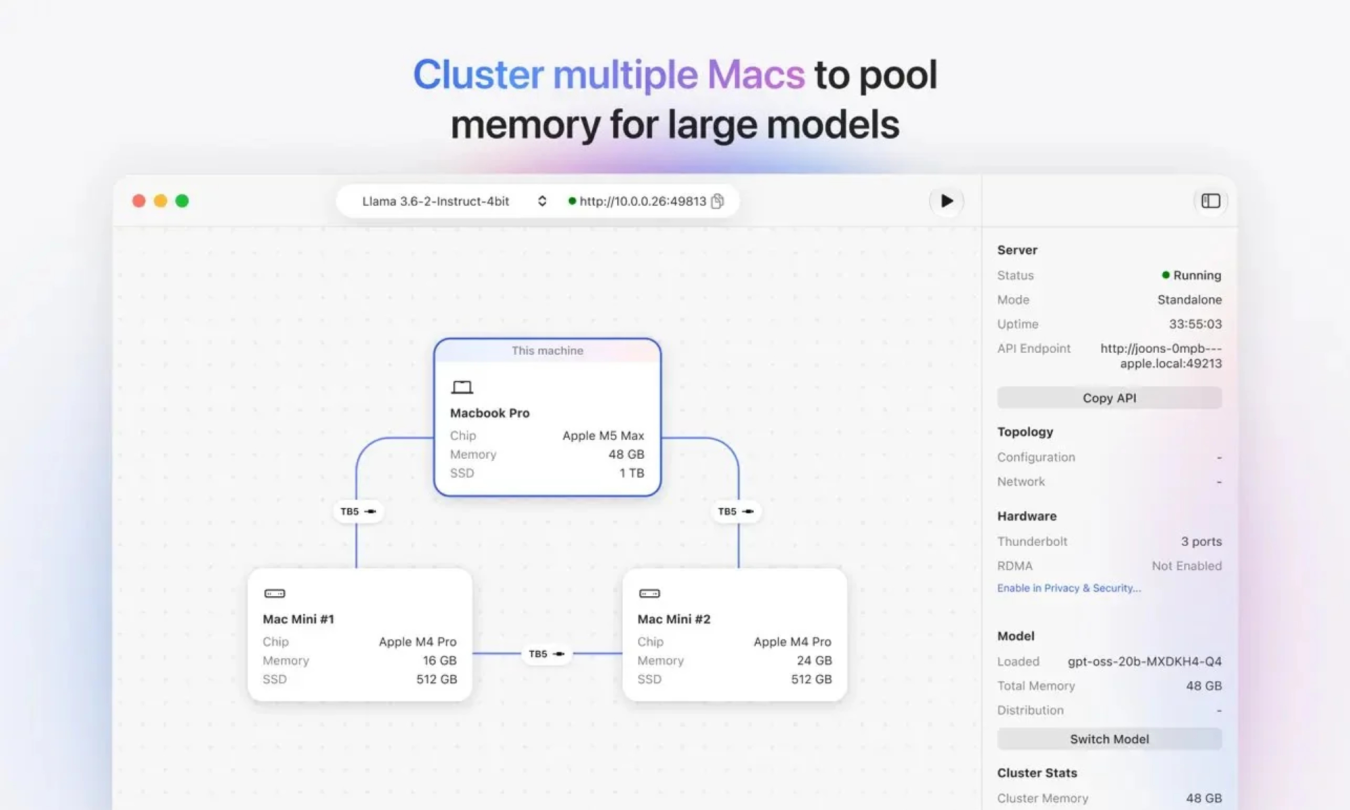
Harbor can connect two or more compatible Macs using Thunderbolt 5, combining their unified memory into a shared resource.
That means models too large for one computer could potentially run across several machines, while additional capacity could support more simultaneous requests.
And according to the app’s description, Harbor can automatically detect connected devices and configure the system without command-line instructions.
It’s the kind of functionality that previously required specialized knowledge, now being packaged into something much more accessible.
For developers, small businesses and anyone experimenting with their own AI tools, that could remove a significant barrier.
The next AI battleground might be your own computer
Local AI isn’t new. Applications like LM Studio and projects like Exo already let users run models on their own hardware.
What’s interesting is Apple’s potential role in making the experience mainstream.
Instead of competing only to provide the smartest AI assistant, Apple could help make the Mac a practical home for independent AI applications, private assistants and automated workflows.
There are limitations. Local models still depend on available computing power, memory and energy. Harbor’s actual performance, supported hardware and commercial availability remain unknown.
But the direction is significant.
As AI becomes more deeply integrated into personal and professional workflows, where that intelligence runs could become just as important as what it can do.
And if Apple succeeds in making local AI simple enough for everyday users, the next big shift in artificial intelligence might not require another cloud subscription.
It might just require a Mac.