


Facebook is giving users more ways to steer what appears in their feeds. The important detail is that Meta is not handing over the controls. It is letting people influence the recommendation system while keeping the recommendation system firmly in charge.
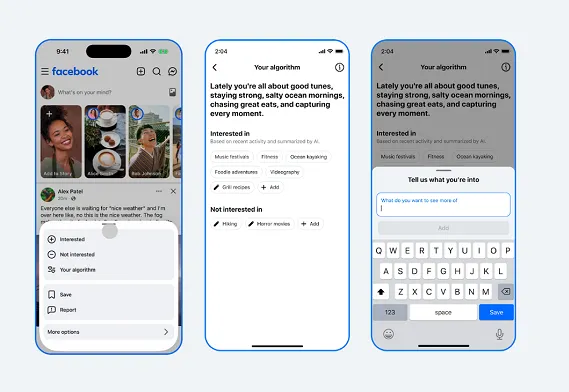
Meta describes how its Your Algorithm controls allow people to add or remove topics from an interest list built from their activity in the app. Users can also use a chatbot prompt to tell Facebook what they want to see more of.
Facebook is turning feed preference into a conversation
The feature is more ambitious than a simple list of topics. Meta says an interest profile is generated from signals that are regularly refreshed, with a large language model turning those signals into readable topic names. Users can then adjust the profile directly, rather than waiting for the system to infer every preference from likes, follows, watch time, and other behavior.
That creates a cleaner interface for a process that has traditionally been invisible. Instead of asking users to understand why a post appeared, Facebook gives them a way to describe the kind of feed they want.
There is also a deliberate time limit on the strongest effect of a new preference. When someone adds an interest, Meta gives that topic extra weight for a limited period so the user can see the change. After that, the topic is treated more like any other signal, with future interactions influencing how much it matters.
That detail is central. A preference is not a permanent instruction. It is a temporary push that enters the same ranking system as everything else. The user gets a more visible say, but the algorithm still decides how long that say remains influential.
The control is real, but it does not remove ranking
Meta also separates topic preferences from broader requests about content quality. Social Media Today reports that requests to reduce AI-generated or sexually suggestive content are handled through dedicated demotion signals rather than ordinary topic matching. In practice, that means Facebook can push down material associated with a quality concern without treating the request as a conventional interest.
The distinction matters because “show me less of this” can mean several different things. A user may dislike a topic, distrust a content type, or simply want fewer posts from one particular creator. Meta says the last case can result in that creator’s content being filtered out directly, while broader quality requests are handled through ranking signals and near-match comparisons.
None of this creates a chronological feed. It creates a more legible version of an algorithmic one.
That is likely the larger purpose. Recommendation systems have become a source of public pressure for platforms, particularly as governments and researchers question the effects of automated amplification. A visible control layer gives users an explanation and an intervention point without requiring Meta to give up the feed mechanics that drive attention.
For Meta, that is the useful compromise. People can feel more agency, while the company keeps the recommendation engine that has helped increase time spent across Facebook and Instagram. The tension is that user control may be most persuasive when it feels powerful, even if the underlying system remains largely intact.
The strategic consequence is straightforward: platforms are moving from hiding personalization to making it conversational. The next fight will not only be over whether algorithms rank content. It will be over how much influence users believe they have over the ranking, and whether that influence is strong enough to satisfy them.