


Daily word games have spent years competing on grids, streaks and bragging rights. Dartwords is trying something more useful: someone to argue with.
The new browser-based game from The Game Band, the studio behind Blaseball, challenges players to discover one secret word each day. You get ten attempts, but no opening hint. Simply enter any word and a tiny, expressive dart named Darty responds with a clue designed to move you closer to the answer.
Each guess also sends a dart toward an on-screen board. The closer your word is to the solution, the closer the dart lands to the bullseye.
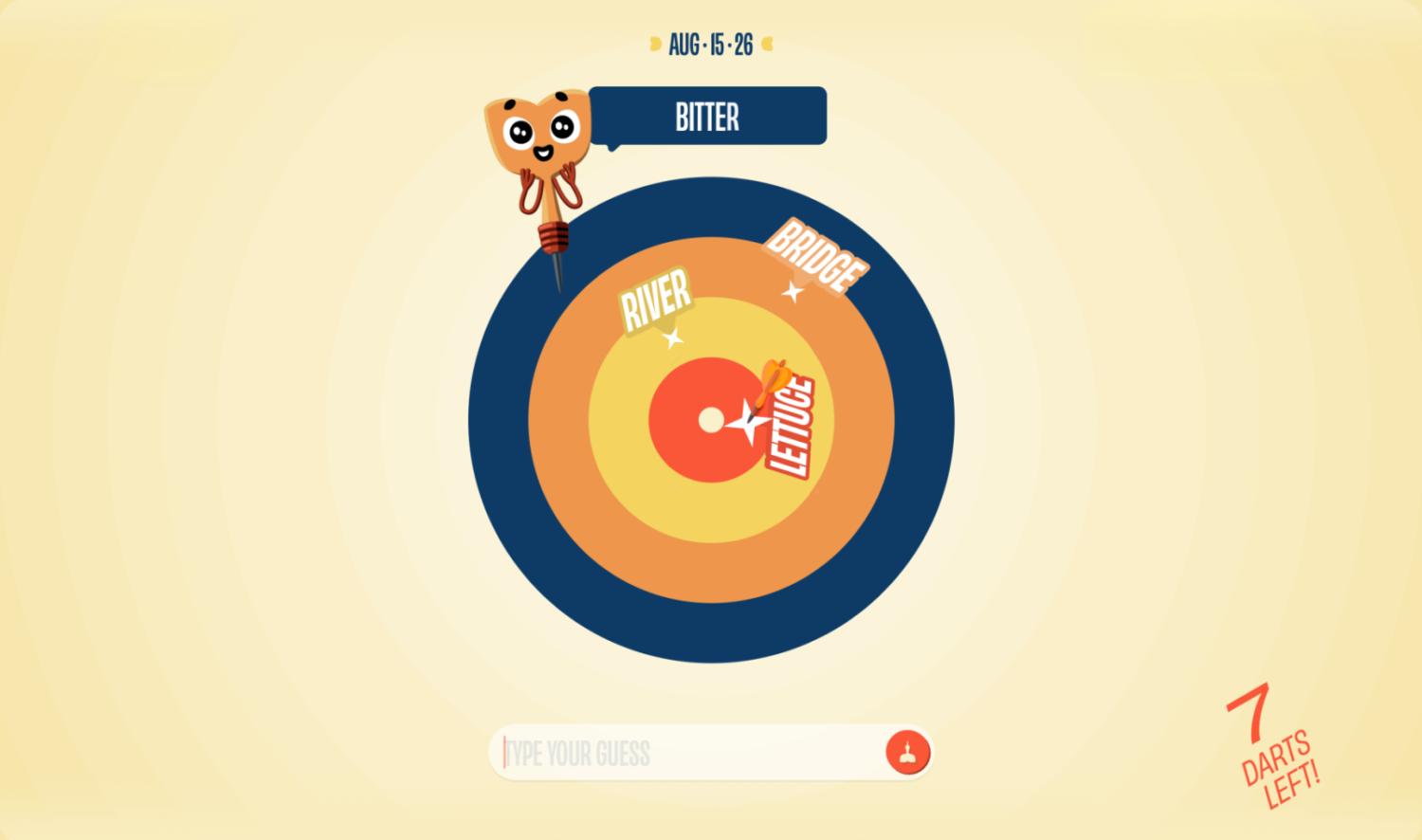
Ten Guesses And One Chatty Dart
Unlike Wordle, Dartwords does not ask players to work through letters and fixed positions. Its clues are more conversational. Guess an animal, for example, and Darty might tell you the answer is larger, manufactured or belongs to a completely different category.
The game uses a custom hint engine built around a local language model trained on the English dictionary. Broader clues are model-generated, while developers step in with hand-written hints as players move closer to the answer.
The studio says the artwork, interface and user experience were all made by humans. AI is helping power the conversation, not drawing the character players are meant to connect with.
Clippy, But Make It A Dart
Darty was directly inspired by Microsoft’s famously intrusive Office assistant. He has large eyes, tiny clapping hands and enough personality to become the obvious target when a clue sends you in the wrong direction.
That may be Dartwords’ smartest idea.
The daily puzzle market is crowded, and most games now offer some variation of the same basic ritual: solve, protect the streak and share the result. Dartwords adds a character to that loop. The game does not simply give feedback. It gives the feedback a face.
Sometimes the smallest piece of personality is enough to make a familiar format feel new again. And if Darty gives you a terrible clue, at least you know exactly who to blame.