


Snapchat is doubling down on its map experience with “Place Loyalty” badges, a new feature that turns your real-world habits into a form of social currency. A new kind of flex, based on where you actually go.
Here’s how it works:
- If you’re in the top 25% of visitors to a place, you’ll unlock a badge
- Top 10% earns you silver
- Top 1% gets you gold
These rankings are based on visits over the past year, turning everyday routines, your go-to coffee shop, gym, or hangout, into a visible signal of loyalty.
Importantly, the feature remains opt-in. Users must choose to share their location, and the rankings are only visible to them unless they decide to share.
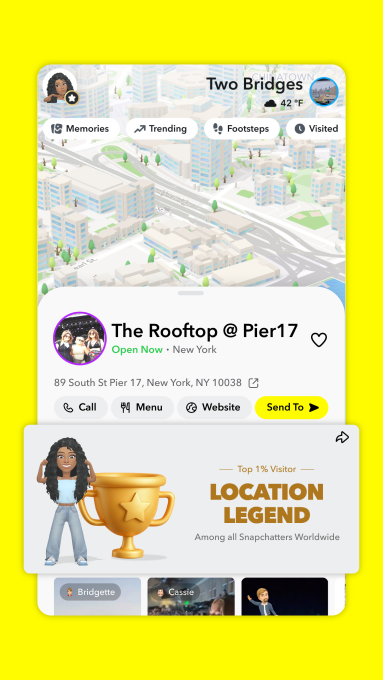
From utility to identity
What started in 2017 as a simple location-sharing tool has quietly become one of Snapchat’s most powerful surfaces. Today, Snap Map isn’t just about seeing where your friends are, it’s about discovering places, tracking experiences, and now, signaling identity through behavior.
With over 400 million monthly users, Snap Map has evolved into a hybrid of:
- local discovery engine
- personal memory tracker
- social status layer
“Place Loyalty” adds a new dimension: turning physical presence into digital recognition.
Why this matters for culture (and brands)
This update taps into a deeper shift in social behavior: people increasingly define themselves not just by what they post, but by where they go.
For users, it’s subtle gamification.
For brands, it’s something more powerful:
- Repeat visits become visible signals of affinity
- Physical locations gain a new layer of digital prestige
- Loyalty starts to look and feel like a badge of honor
And with features like Promoted Places already in play, the connection between discovery, foot traffic, and status is becoming tighter.
Snapchat isn’t just adding features, it’s reinforcing Snap Map as a core product in a world where platforms are competing to own discovery.
With Instagram launching its own map and others pushing into local search, Snap’s advantage lies in something harder to replicate: behavioral data tied to real-world movement.
“Place Loyalty” might seem small, but it points to a bigger direction, a future where your map isn’t just where you are, but who you are.